Taking notes from a textbook is not about rewriting every page. It is about turning a chapter into a small set of ideas you can explain, find, and review later. The most useful process starts before you read closely: preview the chapter, decide what you are looking for, then write notes after you understand the point.
This guide gives you a repeatable workflow for science, history, business, literature, and other reading-heavy courses. You can use it in a notebook, a document, or a note-taking app.
1. Preview the Chapter Before You Start Taking Notes
Spend a few minutes looking at the chapter title, learning objectives, section headings, bold terms, diagrams, charts, captions, and end-of-chapter questions. This gives you a map before you begin reading closely.
Do not start with a blank page and try to capture everything. First decide what the chapter appears to be teaching: a process, an argument, a set of definitions, a historical sequence, or a problem-solving method. The Open University recommends using reading approaches such as skimming, scanning, focused reading, and note-writing as distinct steps rather than treating every page the same way. [1]
2. Turn Headings Into Questions
Use each heading as a prompt. For example:
- “Cellular Respiration” becomes “What does cellular respiration produce?”
- “Causes of the Civil War” becomes “Which causes mattered most, and how did they connect?”
- “Supply and Demand” becomes “What makes a supply curve shift?”
Write these questions down before or while you read. They give your notes a purpose and make it easier to test yourself later.
3. Read One Section for Meaning First
Read a short section without stopping every sentence to copy it. Pay attention to the author’s main claim, the explanation that supports it, and the example that makes it concrete.
If you stop to write before you understand the section, your notes can become a second copy of the textbook. A better approach is to pause at the end of a paragraph group, close or look away from the book, and write the key idea in your own words. The Open University’s guidance on making notes similarly emphasizes understanding material before trying to record it in detail. [2]
4. Use a Simple Concept Structure
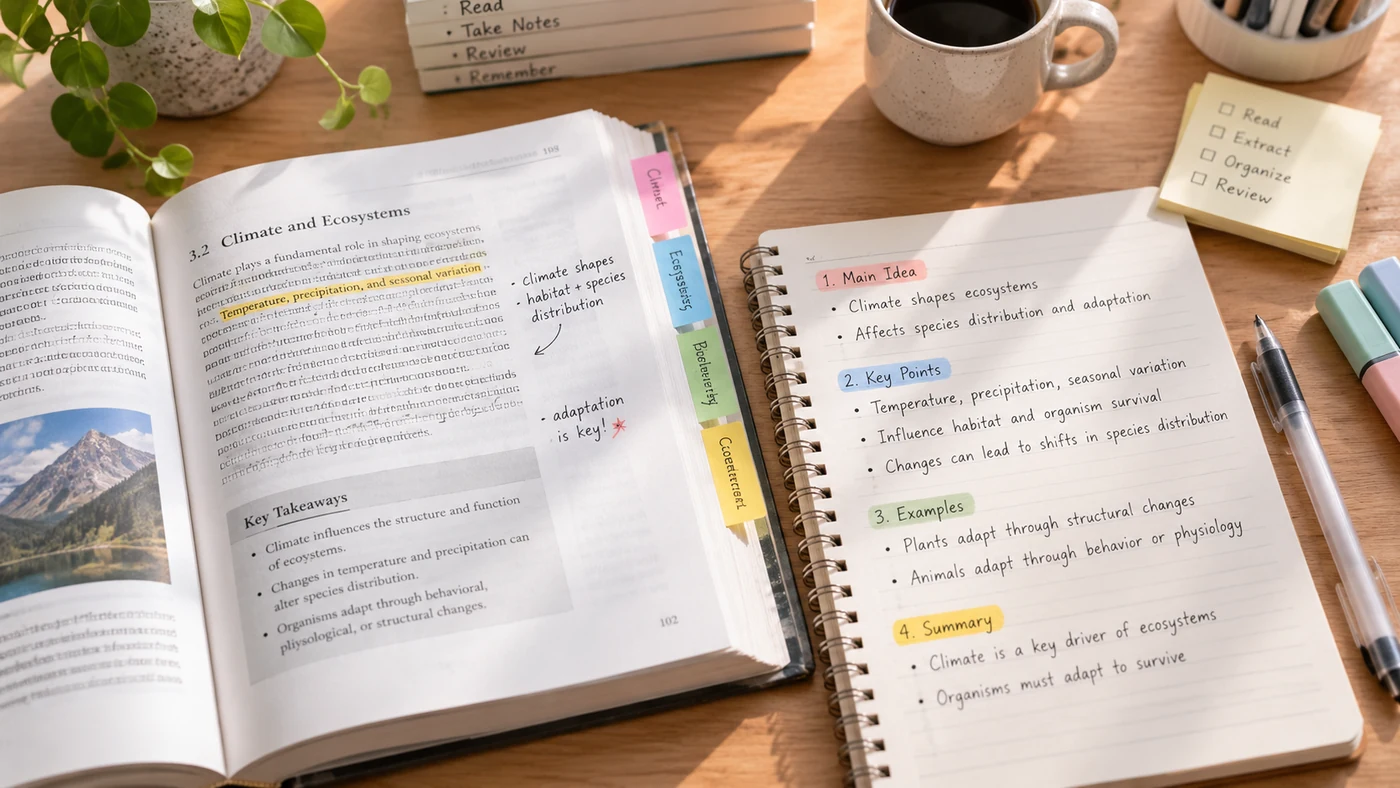
For each section, organize notes in four layers:
- Main idea: What is the section trying to explain?
- Key concepts: Which terms, causes, steps, or principles matter?
- Evidence or example: What case, diagram, formula, date, or quotation helps explain the idea?
- Your connection: What is confusing, surprising, or connected to something you learned earlier?
This structure keeps a chapter from becoming one long list. It also makes gaps visible: if you can name a term but cannot explain it, you know what to revisit.
5. Record Page Numbers and Figure Locations
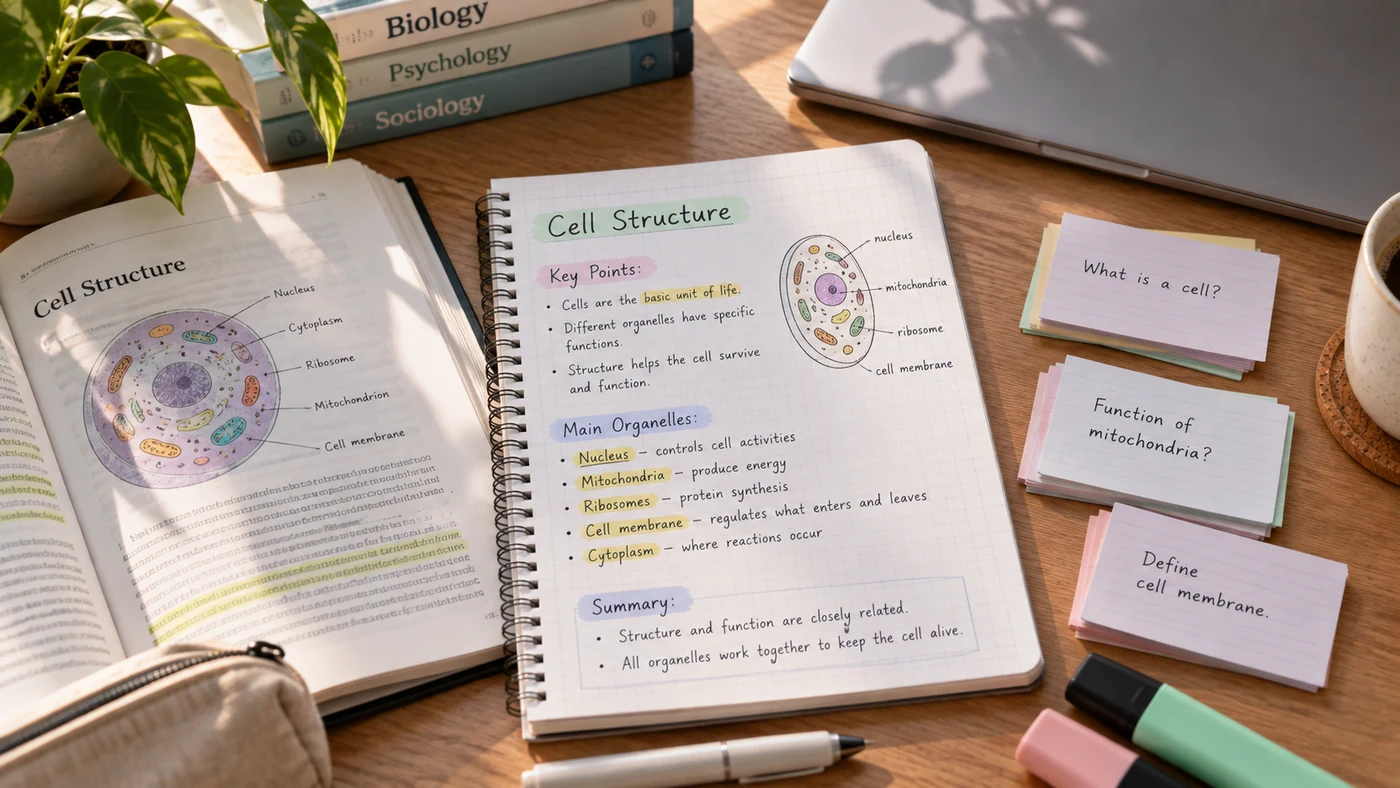
Add a page number whenever you note a definition, quotation, table, or diagram. For visual material, include a quick label such as “Figure 4.2: water cycle” or “Table 3.1: market types.”
These small references save time later. Instead of rereading an entire chapter before an exam, you can return to the exact page where the textbook explained the point.
6. Mark, Do Not Copy
Highlighting can help you find important passages again, but it is not a substitute for notes. Keep highlights selective. Aim to mark only the phrase, definition, claim, or example you may need to locate later.
Then turn the important highlight into a note that answers one of your questions. For example, instead of copying a paragraph about photosynthesis, write: “Plants convert light energy into chemical energy; chlorophyll captures the light.” Add the page number after it.
7. Write a Chapter Summary From Memory
At the end of the chapter, write a five- to eight-sentence summary without looking at the book first. Include:
- the chapter’s central idea;
- three to five key concepts;
- one important example or diagram; and
- one question you still need answered.
Then compare the summary with the textbook and correct what you missed. This step turns note-taking into active recall instead of passive copying.
8. Schedule a Short Review
Review your notes soon after reading, then revisit them before the next class, quiz, or exam. During review, cover your answers and try to respond to the heading questions from memory. Add missing details only after you try to retrieve the idea yourself.
If you keep your notes digitally, link the chapter note to your broader note-taking methods system. Students who want a wider study workflow can also explore note-taking for students and how to take notes every day.
An Optional 5R Check
The 5R method is one optional way to review your work: record, reduce, recite, reflect, and review. You do not need to follow it perfectly. Its value is that it reminds you to reduce a long reading into prompts, explain ideas out loud or from memory, connect them to other knowledge, and come back later.
Use it as a check on your chapter notes, not as a reason to add more steps than you can maintain.
Frequently Asked Questions
What is the best way to take notes from a textbook?
Preview the chapter, turn headings into questions, read one short section for meaning, write the key idea in your own words, record page numbers, and finish with a short chapter summary. This gives you notes you can use for revision instead of a copied version of the book.
Can ChatGPT make notes from a textbook?
Do not treat an AI-generated response as a replacement for reading, course instructions, or your own notes. Before sharing textbook material with any AI tool, check your school’s academic-integrity rules, the tool’s current terms, and any copyright or privacy requirements. Compare every generated point with the original chapter before using it for study.
Conclusion
Good textbook notes make a chapter easier to understand the second time, not just easier to copy the first time. Focus on questions, main ideas, your own explanations, and page references. Then test the notes with a short summary from memory.
Use the workflow on one chapter this week. If you can find a concept quickly, explain it without looking, and identify one question to review, your notes are doing their job.