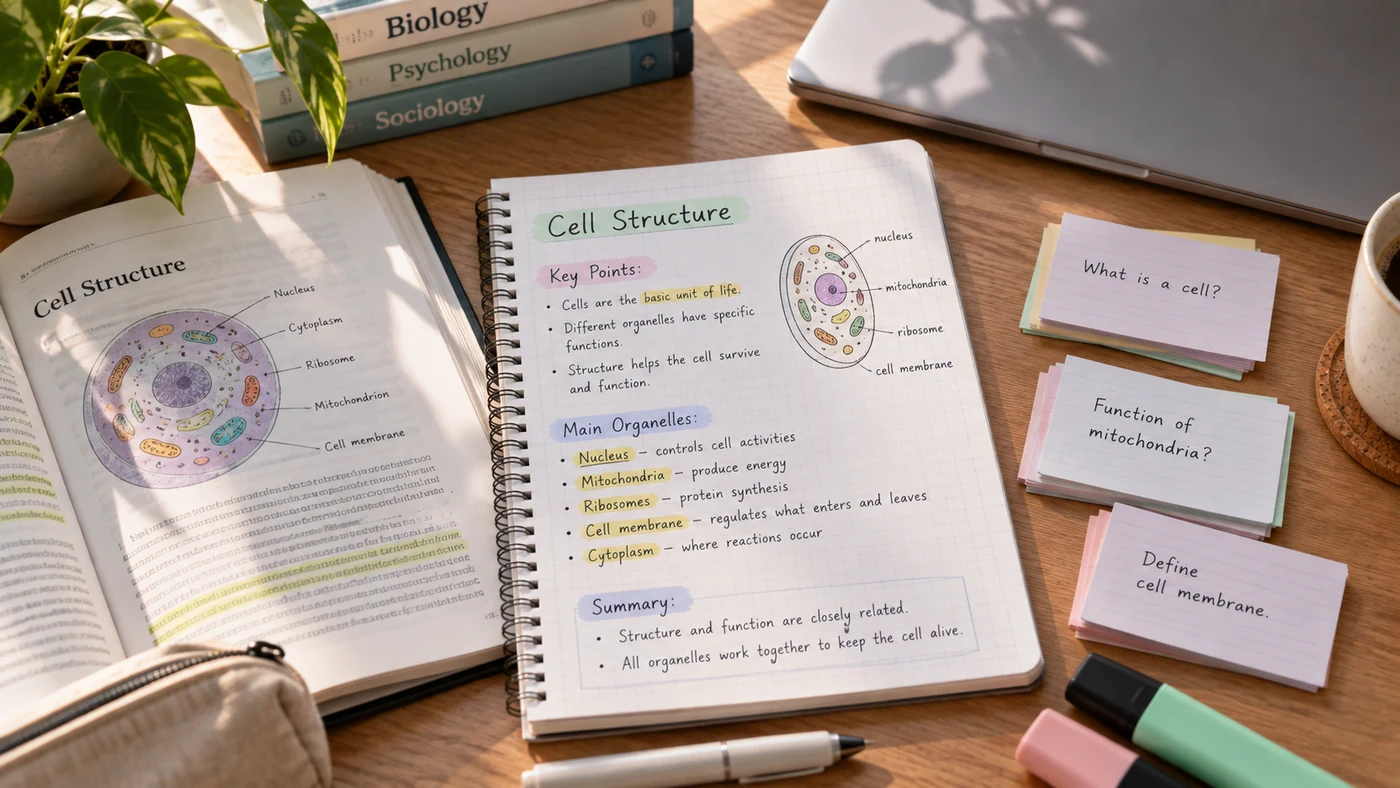
Study note templates are most useful when they match the work in front of you. A lecture, a chapter, a revision session, and a video lesson create different kinds of information. Pick the page that gives that information a clear home, then copy it into a document or draw it on paper.
Choose the Page by the Learning Task
Use a lecture layout when you need to capture ideas quickly. Use a reading layout when you must separate an author's point from your response. Use a revision page when recall matters more than transcription. Use a video page when timestamps and follow-up actions matter.
The Cornell system is one useful example of task-led structure: it separates notes, cues, and a short summary so readers can review a page after class or after reading.[1][2]
1. Class Notes Template
Use this during a lecture or discussion. Leave the questions for after class, when you know what was actually important.
COURSE: ____________________     DATE: __________
TOPIC: __________________________________________

NOTES
- _______________________________________________
- _______________________________________________
- _______________________________________________

QUESTIONS OR TERMS TO CHECK
- _______________________________________________

ONE-SENTENCE TAKEAWAY
__________________________________________________
Write phrases rather than full sentences when the pace is fast. Mark uncertainty with a question mark instead of stopping the whole page to fix it.
2. Reading Notes Template
Use this for a chapter, article, or assigned source. It prevents quotations, summaries, and your own response from blending together.
SOURCE: _________________________________________
PURPOSE OF THIS READING: _________________________

AUTHOR'S MAIN POINT
__________________________________________________

EVIDENCE OR EXAMPLES
- _______________________________________________
- _______________________________________________

MY RESPONSE OR CONNECTION
__________________________________________________

ONE QUESTION TO DISCUSS
__________________________________________________
If you are reading to prepare for an exam, turn the final question into something you can answer without looking at the page.
3. Revision Notes Template
Use this after class, not while trying to capture every detail. It is designed to show what you can recall and what needs another pass.
UNIT: ___________________________________________

I CAN EXPLAIN
- _______________________________________________

I NEED TO REVIEW
- _______________________________________________

PRACTICE PROMPT
__________________________________________________

ANSWER FROM MEMORY
__________________________________________________
4. Video Lesson Template
Use this when you need to return to a specific explanation without replaying the entire lesson.
VIDEO: __________________________________________

TIMESTAMP       IDEA OR DEMONSTRATION
__________      __________________________________
__________      __________________________________

TRY THIS NEXT
__________________________________________________

UNRESOLVED QUESTION
__________________________________________________
Keep the System Small Enough to Use
One page cannot do every job. Start with one layout for a week, then keep only the fields you revisit. If you want a broader framework before choosing a page, this guide to note-taking methods explains several approaches. For routines that connect notes to classwork and review, see these note-taking tips for students.
Conclusion
The best study note template is the one that makes your next action obvious: capture, question, recall, or practise. Match the page to the task, and your notes become easier to use when study time arrives.
References
- Stanford Center for Teaching and Learning. "The Cornell Method of Taking Notes"
- K20 Center, University of Oklahoma. "Cornell Notes System"