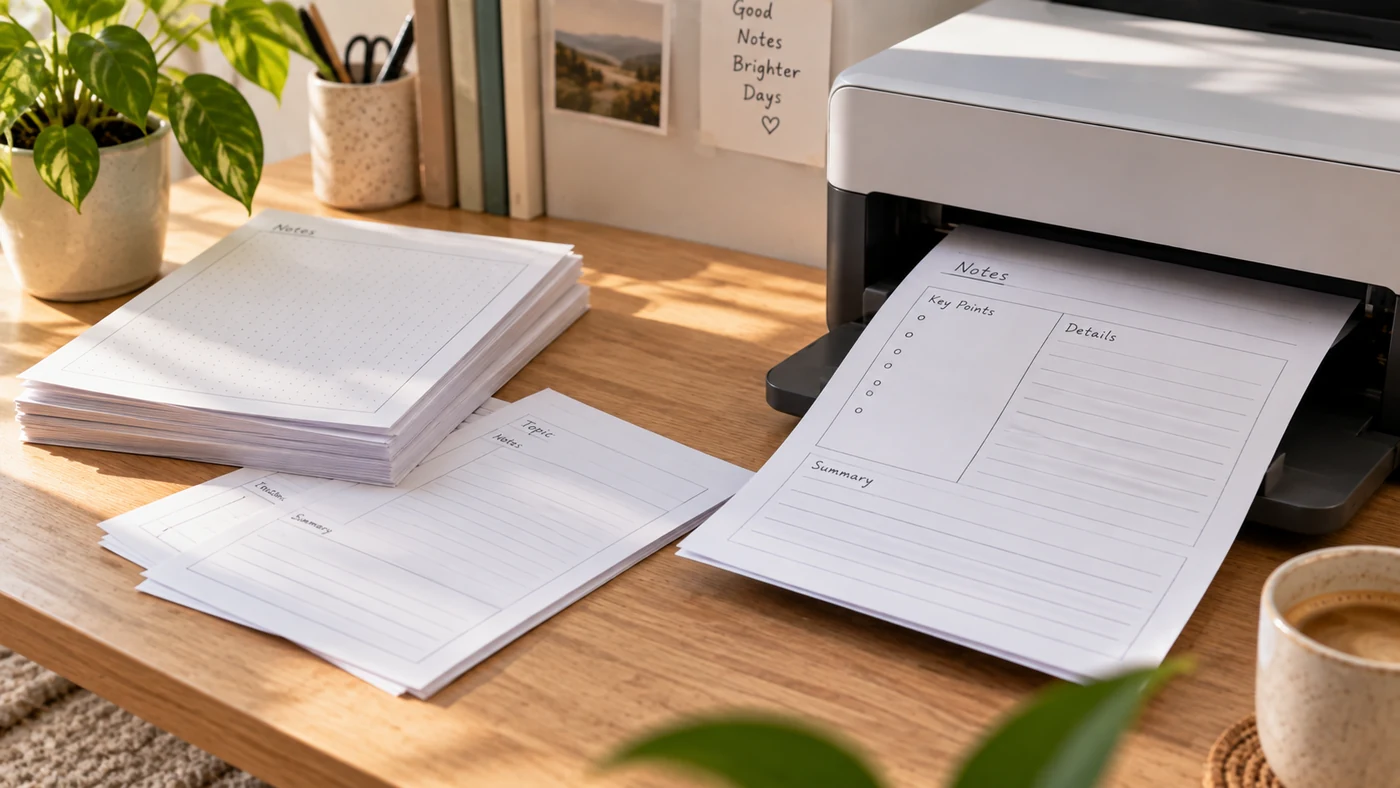
Printable notes templates give you a page with a job before you begin writing. Choose lined paper for sustained notes, dot-grid paper for diagrams, divided pages for comparison, Cornell pages for review, and a planning page for work that has a next step.
Pick the Paper That Matches the Work
| If you need to… | Start with… | Why it fits |
|---|---|---|
| Capture a lecture or meeting | Lined page | It keeps sequential ideas readable. |
| Draw a process or sketch a diagram | Dot-grid page | The light grid supports alignment without forcing lines of text. |
| Compare two ideas or sources | Divided page | Each side has a clear purpose. |
| Review concepts after class | Cornell page | Cues and a summary create prompts for recall.[1] |
| Plan a small project | Action page | It separates decisions, tasks, and follow-up. |
There is no universally best note format. A useful format makes the next task easier: recording, comparing, recalling, or acting on information.
Five Printable Note Page Templates
1. Lined Notes Page
TOPIC: ____________________     DATE: __________

__________________________________________________
__________________________________________________
__________________________________________________
__________________________________________________
Use it for material that unfolds in sequence. Add a short topic line so loose pages stay identifiable later.
2. Dot-Grid Notes Page
TITLE: __________________________________________

·   ·   ·   ·   ·   ·   ·   ·   ·   ·   ·   ·
·   ·   ·   ·   ·   ·   ·   ·   ·   ·   ·   ·
·   ·   ·   ·   ·   ·   ·   ·   ·   ·   ·   ·
·   ·   ·   ·   ·   ·   ·   ·   ·   ·   ·   ·
Use it when a diagram, a table, and a few notes need to share one page. Keep the dots subtle when you print so they guide the layout without competing with handwriting.
3. Divided Comparison Page
TOPIC: __________________________________________

IDEA OR SOURCE A             IDEA OR SOURCE B
______________________       _____________________
______________________       _____________________
______________________       _____________________

WHAT CONNECTS THEM?
__________________________________________________
Use it for arguments, options, before-and-after notes, or two related readings.
4. Cornell Review Page
TOPIC: __________________________________________

CUES OR QUESTIONS | NOTES
__________________|______________________________
__________________|______________________________
__________________|______________________________

SUMMARY
__________________________________________________
Cornell pages separate the main notes from cues and a short summary, a structure that supports review after reading or class.[2]
5. Action Notes Page
PROJECT OR MEETING: ______________________________

DECISIONS
- _______________________________________________

NEXT ACTIONS
□ _______________________________________________
□ _______________________________________________

CHECK-IN DATE: __________________________________
Use it when notes need to lead to an action, not just preserve information.
Print Before You Commit to a Stack
Print one test page before preparing a full set. Write on it with the pen you normally use, check the margins, and make sure the page still works when it is not perfectly centered in a binder. For a broader explanation of which note structure fits which situation, see these note-taking methods. If you are turning a digital draft into paper, this guide to exporting and printing notes can help with the practical steps.
Frequently Asked Questions
What is the best format to take notes?
The best format depends on the job. Choose lined paper for sequential information, dot-grid paper for mixed notes and diagrams, divided pages for comparison, Cornell pages for recall prompts, and action pages when you need follow-up. Start with the task rather than trying to find one format for everything.
Conclusion
Printable note pages work when their structure disappears into the task. Try one page for a real class, reading session, or project, then keep the format that makes review and follow-up easier.
References
- University of Tennessee at Chattanooga. "Common Note-taking Methods"
- Stanford Center for Teaching and Learning. "The Cornell Method of Taking Notes"