An exam study plan template works best when it starts with the exam date and the time you have. List the topics, place practice and review before test day, and leave buffer sessions for missed work or difficult material. The copyable schedule below turns those decisions into a plan you can adjust rather than a calendar packed with impossible promises.
Quick-start fields before you schedule
Write down four things first: the exam date, the topics or units covered, the study sessions you can realistically use, and fixed commitments that reduce that time. This is the plan's starting point—not a promise to fill every open hour. Once these are clear, you can work backward and assign review, practice, and buffer sessions.
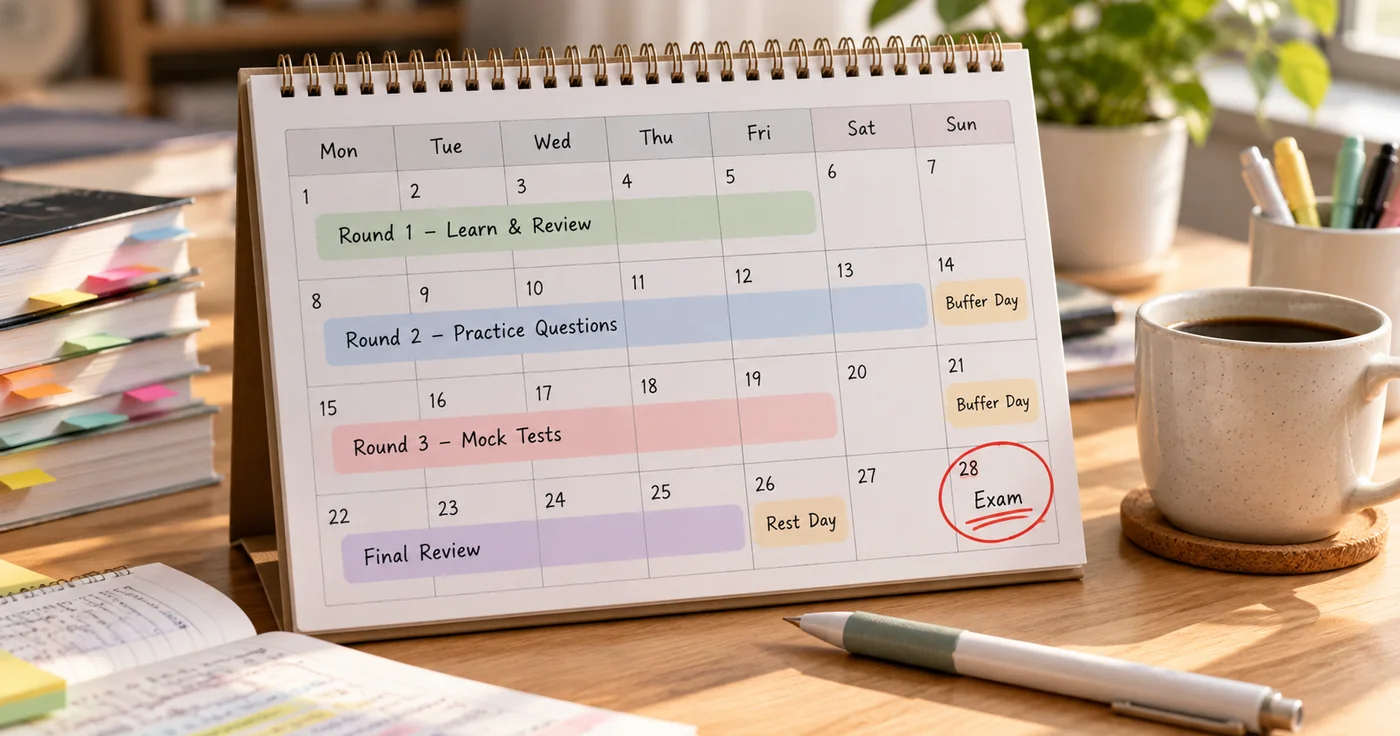
Work backward from the exam date
Write down the exam date, the topics it covers, and any fixed commitments between now and then. Count usable study sessions, not empty calendar days. A 30-minute session after work and a longer weekend block should not be treated as equal.
Then reserve time in this order:
- Final check: a light review and practical preparation before exam day.
- Practice round: questions or tasks that resemble what you expect to do in the exam.
- First review round: coverage of each topic, with notes on what you cannot yet answer.
- Buffer sessions: unscheduled space to revisit weak areas or absorb an interruption.
Only after those blocks are visible should you assign specific topics to individual sessions. This prevents the plan from spending every available day on first-pass reading and leaving no time to test yourself.
Estimate the work without filling every hour
For each topic, write a concrete output instead of a vague instruction such as “study Unit 2.” Examples include “answer five questions without notes,” “explain the process on one page,” or “check mistakes from the last practice set.” You can revise the output after you see how long it takes.
Give the hardest or least familiar topics more than one session. Keep shorter tasks for busy days. If your available time changes, move or reduce tasks deliberately rather than squeezing all missed work into the next evening.
This page is a deadline-driven exam project. For a general rhythm of appointments and everyday tasks, use a separate weekly planning routine.
Copy this blank exam study plan
Fill in the exam date first. A “buffer” row is intentionally open: use it only for work that needs more time, not as a hidden extra topic.
EXAM STUDY PLAN
Exam / date:
Topics to cover:
Available study sessions per week:
Session length on busy days / open days:

| Date or relative day | Focus and specific output | Review round | Self-check | Status |
|----------------------|---------------------------|--------------|------------|--------|
|                      |                           | First pass   |            |        |
|                      |                           | First pass   |            |        |
|                      |                           | Review       |            |        |
|                      |                           | Practice     |            |        |
|                      | BUFFER                    | Catch-up     |            |        |
|                      | Light final check         | Final        |            |        |

Weak topics to revisit:
Questions to clarify with the instructor or source:
What I will move or remove if I fall behind:
You can use calendar dates or relative labels such as “21 days before” and “7 days before.” Calendar dates are easier to act on once your actual exam date is confirmed.
See a three-week plan filled in
This example is hypothetical. A student has one exam covering four units and can study on four weekdays for 30 minutes plus one longer weekend session. It shows the allocation logic, not a required number of hours for any course.
EXAM STUDY PLAN
Exam / date: Friday of Week 4
Topics to cover: Units A, B, C, and D
Available study sessions per week: Four short weekdays; one weekend block
Session length on busy days / open days: 30 minutes / 75 minutes

| When       | Focus and specific output                 | Round      | Self-check                         | Status  |
|------------|-------------------------------------------|------------|------------------------------------|---------|
| Week 1 Tue | Unit A: one-page concept map              | First pass | Explain three key ideas aloud      | Planned |
| Week 1 Thu | Unit B: answer four guide questions       | First pass | Mark answers needing source check  | Planned |
| Week 1 Sat | Units A and B: correct missed answers     | Review     | Retry without looking              | Planned |
| Week 2 Tue | Unit C: work through two sample tasks     | First pass | Note where the method breaks down  | Planned |
| Week 2 Thu | Unit D: make a short question set         | First pass | Answer it after a short break      | Planned |
| Week 2 Sat | BUFFER: unfinished topic or weak area     | Catch-up   | Record what still needs attention  | Open    |
| Week 3 Tue | Mixed questions from all four units       | Practice   | Check errors against course notes  | Planned |
| Week 3 Thu | Weakest unit: redo missed questions       | Review     | Try the same skill in a new task   | Planned |
| Week 3 Sat | Timed practice block and error review     | Practice   | List final points to clarify       | Planned |
| Week 4 Wed | Brief check of errors and exam logistics  | Final      | Stop adding new units              | Planned |

Weak topics to revisit: Fill after the Week 2 self-check.
Questions to clarify: Fill from mistakes, not guesses.
If behind: Move a low-priority reread into the buffer block; keep practice.
The open buffer does not promise that everything will fit. If a topic repeatedly takes longer, reduce the plan to the most relevant work and ask for clarification where your course materials do not resolve the gap.
Use notes as inputs, not as the whole study plan
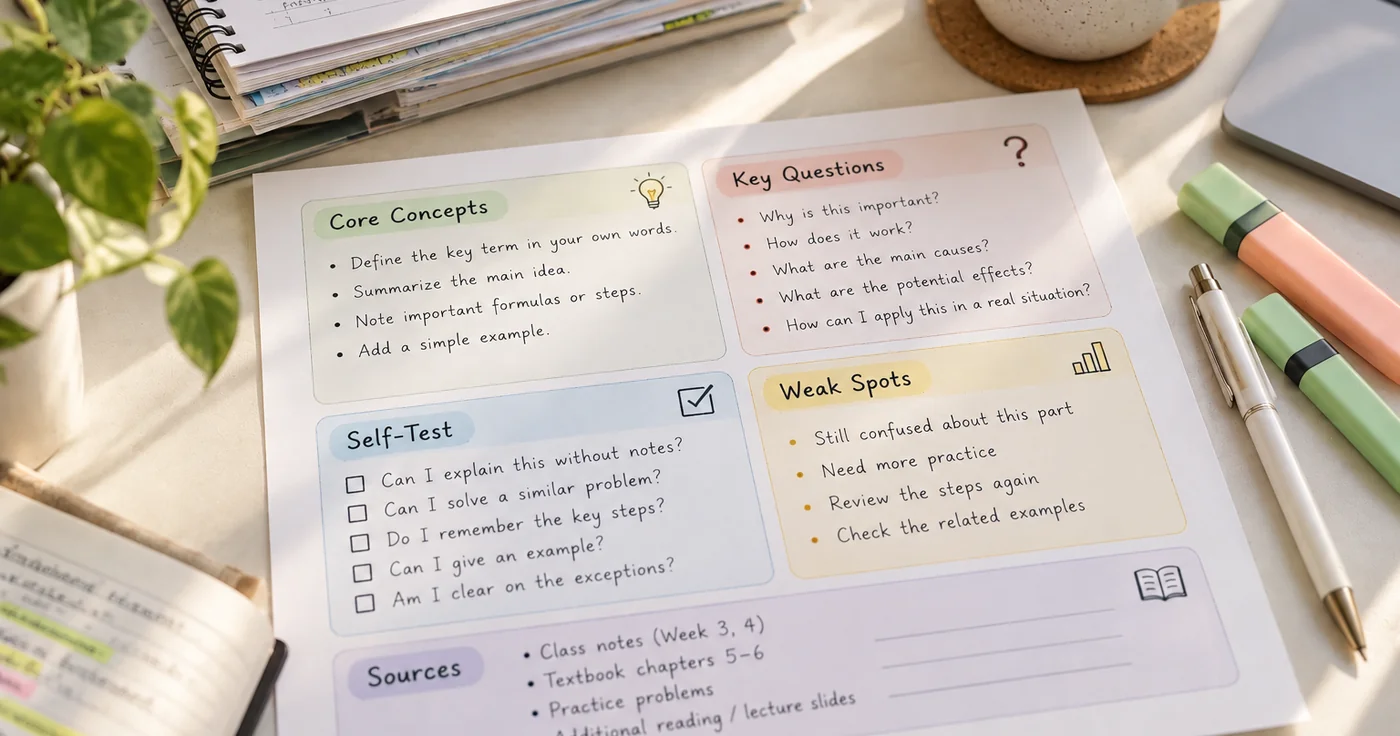
Your class notes show what was covered; the plan specifies what you will produce and check on a given day. Start with the notes or assignments your course actually uses. If those notes are disorganized, note-taking for students offers broader ways to capture and review material without replacing this exam schedule.
At the end of each session, mark it done, moved, or still unclear. Then make one small adjustment to the remaining schedule. A plan that changes in response to real progress is more useful than a perfect-looking grid you stop following.
Conclusion
Build your exam plan from the deadline, your available sessions, and the work you need to demonstrate—not from a wish to cover every page equally. Protect time for practice, weak areas, and at least one buffer session.
Copy the blank plan, enter your real exam date and commitments, and schedule only the first week. Adjust the later blocks after your first self-check.