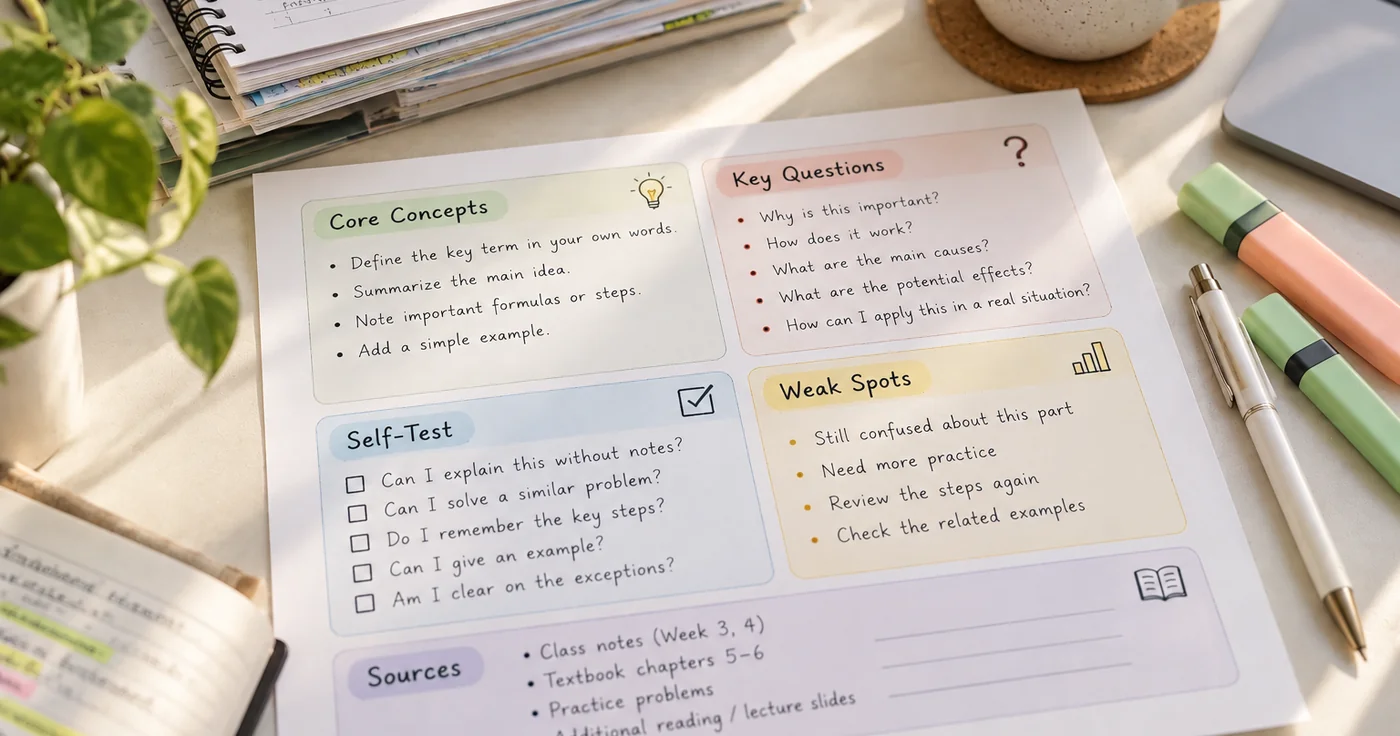
A study guide template turns class notes into a review sheet you can test yourself with. Gather notes for one unit, group ideas by topic, turn headings into questions, and flag what you cannot answer. Include the unit, core concepts in your words, recall or application questions, weak spots, and source pointers; the blank layout and example show how.
Start with a bounded set of notes
Choose one exam unit or topic, not an entire course. Put your lecture notes, assigned reading notes, handouts, and any instructor-provided review points together. Record which source each item came from so you can check an unclear definition or example later.
Do a quick first pass:
- Circle the concepts that appear in more than one set of notes.
- Mark any question the instructor asked you to explain or apply.
- Flag gaps, contradictions, and terms you cannot define without looking.
- Set aside details that are outside the unit you are reviewing.
If you still need a way to capture information during class, use study-note layouts for students. This page starts after you have those notes: it turns them into a review tool.
Build a guide around answers you must produce
A pile of highlighted facts is hard to test. For each topic, give yourself a short concept explanation and at least one question you can answer without looking at the notes. Mix question types when the material calls for them:
- Recall: What does this term mean?
- Comparison: How are these two ideas different?
- Application: What would I do in a new example?
- Explanation: Why does this step or argument follow?
Write the answer in a separate field, or cover it while you try the question. If you cannot answer, mark a specific weak point such as “I confuse the two examples,” not just “review this.” Return to the source note before you rewrite the answer.
Copy this blank study guide layout
Use one copy per unit. Add or remove rows based on the amount of material; the purpose is to make review possible, not to fill every field.
STUDY GUIDE — [unit or topic]
Assessment / date:
Sources used: [lecture dates, reading pages, handouts, class discussion]

1. Core concept or process:
   Explain it in my own words:
   Why it matters in this unit:
   Source to check:

2. Core concept or process:
   Explain it in my own words:
   Why it matters in this unit:
   Source to check:

RECALL AND APPLICATION QUESTIONS
Q1:
My answer, written without notes:
Source or answer check:

Q2:
My answer, written without notes:
Source or answer check:

WEAK SPOTS
- What I cannot explain yet:
- Where I will look:
- How I will test it again:

ONE-PAGE WRAP-UP
- Three ideas I should be able to explain:
- One example I should be able to work through:
- One question to ask before the assessment:
For a large unit, keep the same headings but make several pages by subtopic. A guide becomes less useful when the “one-page wrap-up” tries to replace all the source notes.
See how two sets of notes become one guide
The following is an invented classroom example, not a real course source. Imagine a literature class that discussed a fictional story called The North Window. One lecture addressed the narrator's point of view; a later discussion compared what the narrator says with another character's account. Instead of copying both sessions, a student could make this review sheet:
STUDY GUIDE — Point of view in The North Window (fictional example)
Assessment / date: Unit discussion / Friday
Sources used: Monday lecture notes; Wednesday discussion notes

1. Core concept or process: Narrator's account
   Explain it in my own words: The story is filtered through one person's
   account, so the reader knows what that person chooses to tell.
   Why it matters in this unit: The two accounts of the same event differ.
   Source to check: Monday lecture, section “point of view”

2. Core concept or process: Comparing accounts
   Explain it in my own words: Identify what both characters agree on,
   then notice what each leaves out.
   Why it matters in this unit: The differences change how I interpret
   the scene at the window.
   Source to check: Wednesday discussion, comparison notes

RECALL AND APPLICATION QUESTIONS
Q1: Which detail appears in both accounts?
My answer, written without notes: Both characters mention the open window.
Source or answer check: Wednesday discussion notes

Q2: What would I cite to support a claim about the narrator's limits?
My answer, written without notes: I need a scene where the narrator
reports what happened but cannot know the other character's motive.
Source or answer check: Recheck the assigned passage before using it.

WEAK SPOTS
- What I cannot explain yet: Whether the two accounts actually conflict
  or simply focus on different details.
- Where I will look: The assigned passage and Wednesday discussion notes.
- How I will test it again: Write a short comparison without notes.

ONE-PAGE WRAP-UP
- Three ideas: Point of view; shared details; omitted details.
- One example: Compare the two accounts of the window scene.
- One question to ask: Which passage best supports my comparison?
Notice what changed: two note sets became a small number of concepts, questions, and source pointers. The guide does not pretend that a made-up answer is enough; it tells the student where to verify a passage before using it.
Use the guide to find gaps, not just to reread
Hide the answer fields and respond to each question aloud or in writing. Check against the source notes, then rewrite only the part you missed. When a weak spot is resolved, replace the vague flag with a question you can answer on a later attempt.
If your class notes are thin or confusing, do not invent missing material to make the guide look complete. Ask a specific question in class or consult the assigned source. For broader ways to capture and review information across a term, see note-taking for students.
Conclusion
A useful study guide is a testable map of one unit: concepts in your own words, questions you can answer from memory, weak spots, and pointers back to the original notes. It is not a cleaned-up copy of every page.
Choose one unit today, fill the blank layout from two sets of notes, and try answering its questions before you add more material.