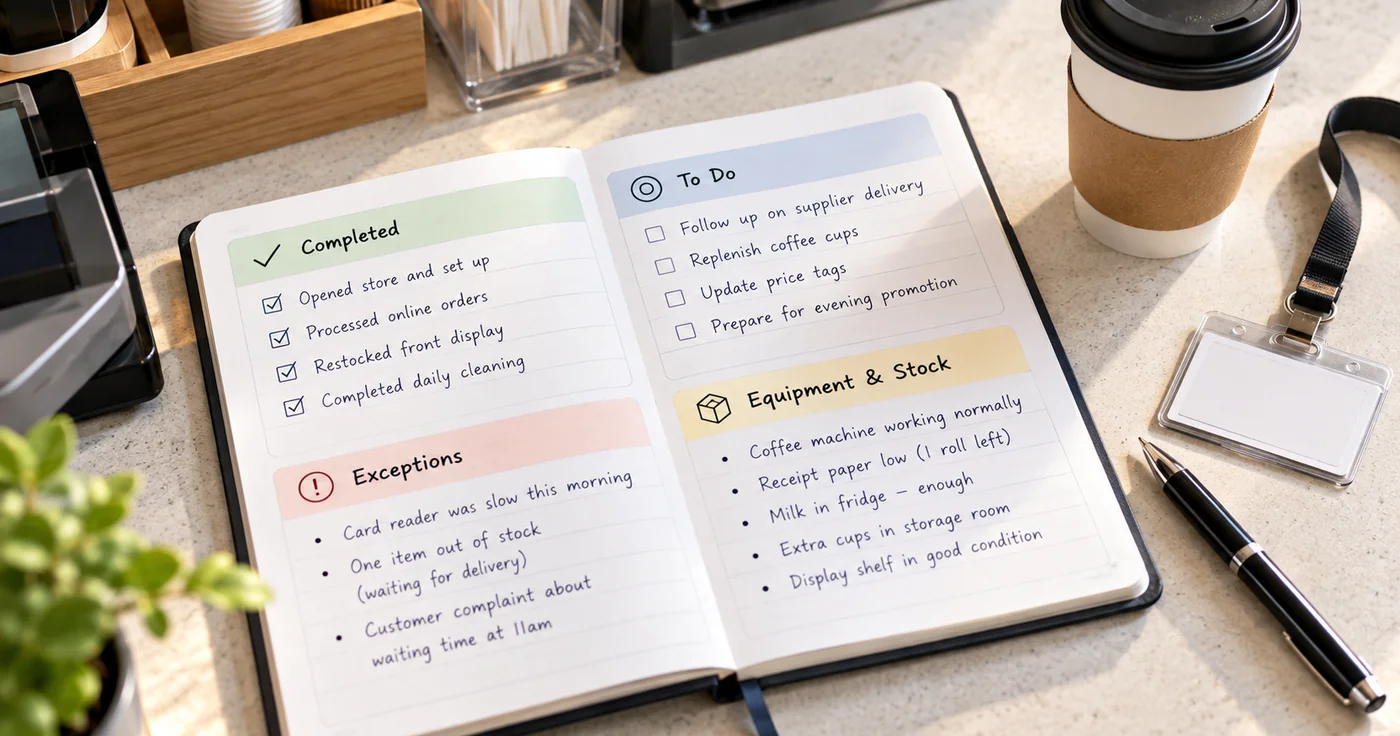
Shift handover notes should let the next person see what is finished, what still needs attention, and who owns the next action. Use this copyable format for a store, service desk, or general operations team. Keep each update specific, put urgent issues first, and leave space for the incoming person to confirm what they are taking over.
Copy this shift handover notes format
SHIFT HANDOVER

Location or team:
Date:
Outgoing shift / handover time:
Incoming shift / next owner:

Completed
- Task or event:
  Status / useful detail:

Still in progress
- Task:
  Current status:
  Next action:
  Owner:
  Due time or priority:

Issues or exceptions
- What happened:
  What has already been done:
  What needs attention:
  Who has been notified (if applicable):

Equipment or stock changes
- Item or equipment:
  Change, shortage, fault, or location:
  Follow-up owner:

Next shift priorities
1.
2.
3.

Incoming-shift check
- Open items reviewed with:
- Questions or corrections:
- Confirmed by / time:
What to include in shift notes
Completed work
Record the meaningful work that is finished, especially anything the incoming person might otherwise repeat or mistake for an open task. Keep the note short: name the task and add the detail needed to understand its status.
Pending tasks and next actions
Write the next action, not just “still working on it.” Add an owner and a useful time or priority when the next shift needs to act. For example, “Check the late delivery with the supplier before opening” gives the next person a clearer handoff than “Delivery issue.”
Issues and exceptions
Separate an unusual event from routine work. State what happened, what has already been done, and what remains unresolved. Avoid guessing about the cause; label anything that still needs checking as an open question.
Equipment and inventory changes
Note a relevant equipment fault, stock shortage, unexpected delivery, or change in where something is stored. Include the item and the follow-up needed so the next shift knows what to check.
The next shift's priorities
Put the most time-sensitive or consequential follow-ups first. A short ordered list is easier to scan than burying priorities inside a long paragraph.
A short example
Fictional example for a general retail or service shift:
Completed
- Front counter restocked; closing checklist finished.

Still in progress
- Replacement receipt printer requested.
  Next action: Check delivery status before the afternoon rush.
  Owner: Incoming shift lead.

Issues or exceptions
- One register intermittently failed to print receipts.
  What has already been done: Issue noted for the manager.
  What needs attention: Test the printer and use the backup register if needed.

Equipment or stock changes
- Receipt paper is low at the front counter; one unopened pack remains in storage.

Next shift priorities
1. Check the printer request.
2. Refill receipt paper if needed.

Incoming-shift check
- Open items reviewed with: Afternoon shift lead.
- Questions or corrections: Confirm which register is the backup.
- Confirmed by / time: Afternoon shift lead, 2:05 p.m.
The example is deliberately brief. Replace the details with your team's actual status, priorities, and handover practices.
Confirm the handover with the incoming shift
Before the outgoing person leaves, ask the incoming person to identify the unresolved items and their next actions. Correct any unclear owner, timing, or equipment status in the note. A written record helps, but it should not be mistaken for confirmation that the next person understood it. The UK Health and Safety Executive's guidance for safety-critical handovers emphasizes two-way communication and cross-checking by incoming staff; adapt that principle to your workplace's own process rather than treating this general template as a safety procedure.[1]
Keep the handover useful and within scope
Use plain language, dates or times when they remove ambiguity, and one owner for each follow-up. If a detail is uncertain, mark it as unconfirmed instead of presenting it as settled. Share only the information the next shift needs and follow your workplace's record-keeping and privacy practices.
This general format is for retail, service, and operations settings. It is not a clinical handover format and should not replace procedures approved for healthcare or other regulated work.
For a broader system for organizing workplace notes, see Work Notes. If you need a reusable structure for other work tasks, browse Work Notes Templates.
Conclusion
Useful shift notes make the next action visible: what is done, what remains, what changed, and who takes responsibility. Keep the handover focused on facts the incoming shift can act on.
Try the format at the next shift change. Remove fields your team does not use, keep the priority list short, and review whether the incoming person can identify the open tasks quickly.
References
- Health and Safety Executive. "Shift handover"