To write meeting minutes, record the meeting details, summarize decisions and essential context, assign each follow-up to an owner, and review the document before sharing it. Good minutes are not a transcript. They give people a reliable record of what the group decided and what happens next.
What meeting minutes are, and what they are not
Meeting minutes are the formal record of actions and outcomes. They are normally more concise and neutral than working notes. In association and board settings, ASAE and Robert’s Rules both distinguish minutes from a record of every comment: minutes document what was done, not every word said. [1][2]
If you only need a personal capture of discussion, use meeting notes. Use minutes when the document will be circulated as the meeting’s shared record.
What to capture during the meeting
Capture raw facts in agenda order instead of trying to polish sentences live:
- Meeting name, date, start and end time, and location or call link
- Attendees, absences, and the person taking minutes
- Each agenda item
- Decisions, approvals, motions, or votes when relevant
- Action items with an owner and deadline
- Topics deferred to another meeting
For a board, nonprofit, public body, or regulated organization, its bylaws, governing rules, and applicable local requirements control. This is a general workplace guide, not legal advice.
How to write meeting minutes in six steps
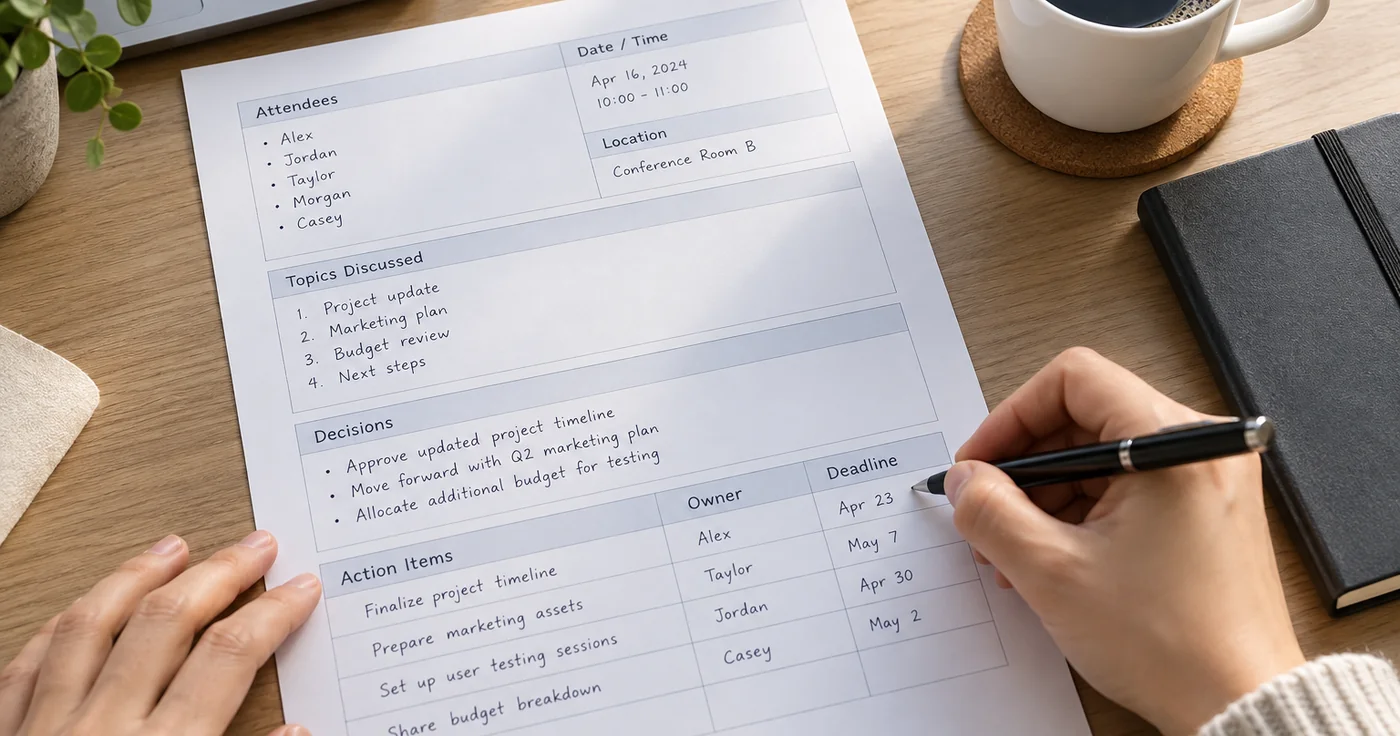
1. Start with the meeting facts
Open with information that identifies the meeting: group, date, time, place or call link, facilitator, minute taker, and attendees. Association guidance commonly includes these facts and the agenda in the basic record. [1]
2. Follow the agenda order
Use one short section per agenda item. This is easier to scan than a chronological stream of notes and connects each outcome to its topic. If an item was skipped, write “Deferred” and state the next step only if one was agreed.
3. Turn discussion into an outcome
For each item, ask: What did the group decide, approve, reject, or defer? What context is needed to understand it? What happens next? Use neutral, past-tense wording: “The team approved the revised launch date,” not a replay of who argued for it.
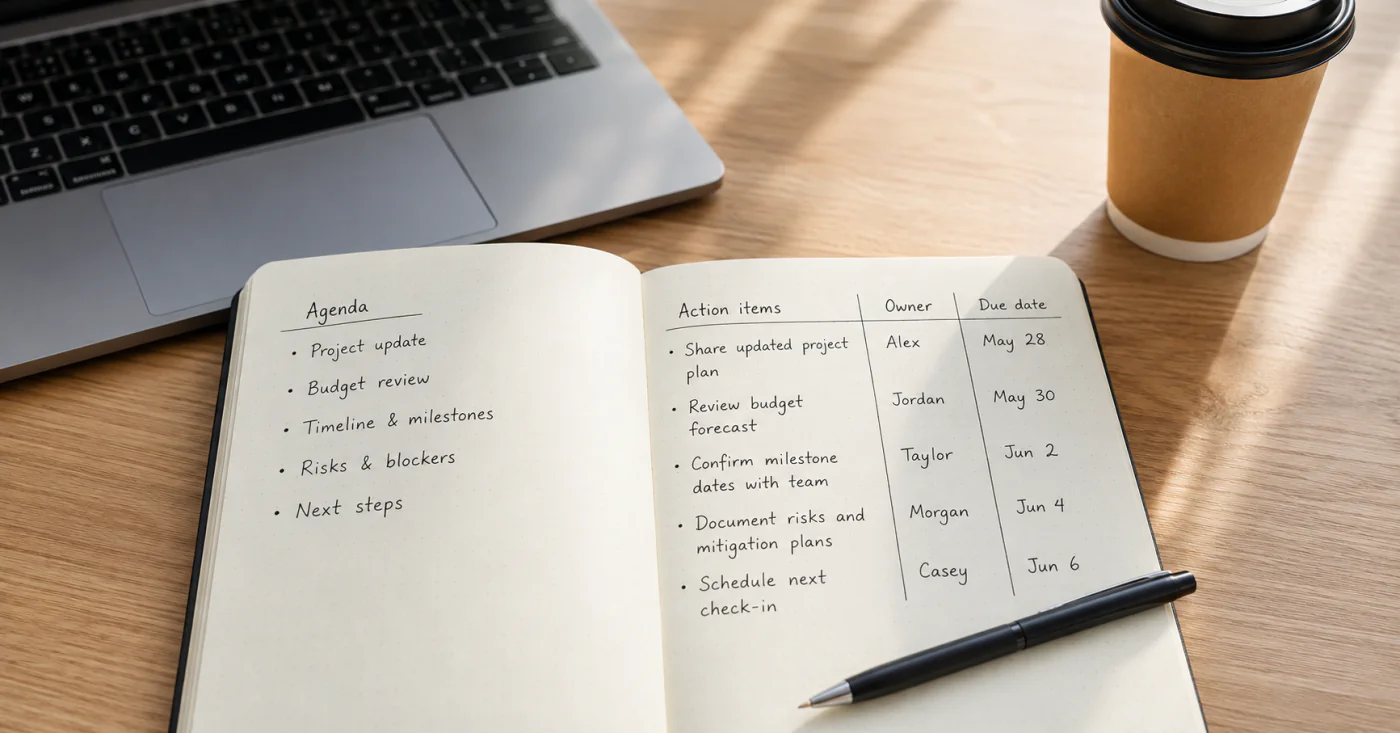
4. Make action items unambiguous
An action item needs a verb, one accountable owner, and a date or trigger. “Marketing to update the page” is vague. “Maya will update the launch page by May 12” is trackable. Agree when the minutes will be written up and shared. [3]
5. Keep the record objective
Do not turn minutes into a transcript, performance review, or archive of every disagreement. Direct quotes, side conversations, and guesses about motives rarely help a reader act later. [1][2]
6. Review, confirm, and distribute
Check names, owners, dates, and decisions against your notes and the team’s normal approval process. If something is unclear, ask the facilitator or decision owner before you send the document.
A copyable meeting minutes format
MEETING MINUTES
Meeting:
Date and time:
Location or call link:
Facilitator:
Minutes recorded by:
Attendees:
Absent:

1. [Agenda item]
   Context needed for the record:
   Decision or outcome:
   Action items:
   - [Owner] will [action] by [date].

2. [Agenda item]
   Context needed for the record:
   Decision or outcome:
   Action items:
   - [Owner] will [action] by [date].

Next meeting:
Minutes approval or review process:
For recurring work, compare other work-note structures and reserve this format for the official record.
Example: completed project meeting minutes
MEETING MINUTES
Meeting: Website launch review
Date and time: May 6, 2026, 10:00–10:45 a.m.
Location or call link: Video call
Facilitator: Priya Shah
Minutes recorded by: Leo Martin
Attendees: Priya Shah, Leo Martin, Maya Chen, Omar Reed
Absent: None

1. Launch date
   Context needed for the record: The final accessibility review needs two more business days.
   Decision or outcome: The team moved the launch from May 8 to May 13.
   Action items:
   - Maya will update the launch page and announcement copy by May 8.
   - Omar will complete the accessibility review by May 11.

2. Customer support coverage
   Context needed for the record: Support expects the highest volume on launch day.
   Decision or outcome: Two team members will monitor the launch inbox for the first four hours.
   Action items:
   - Leo will publish the coverage schedule by May 10.

Next meeting: May 12, 2026, 2:00 p.m.
Minutes approval or review process: Attendees will send corrections to Leo by May 8.
Frequently Asked Questions
What are the four things that meeting minutes should include?
At minimum, include the meeting’s identifying details, who attended, the agenda or matters handled, and the decisions or actions that resulted. Add owners and dates whenever the group assigned follow-up work. Formal organizations may need additional fields under their own rules. [1]
What is the best format for meeting minutes?
For most workplace meetings, follow the agenda and give each item a short context note, an outcome, and any action with an owner and date. A board or other formal group may need a different format under its bylaws, meeting rules, or applicable law.
Conclusion
Useful minutes identify the meeting, organize the record by agenda item, state the outcome, and make each follow-up accountable to someone.
Use this format for one real upcoming meeting, then compare the draft with the facilitator’s decisions before sending it. That review is where vague notes become a reliable shared record.
References
- ASAE. "Do’s and Don’ts for Meeting Minutes"
- Robert’s Rules Association. "Frequently Asked Questions"
- ASAE. "Nine Tips for More Productive Meetings"