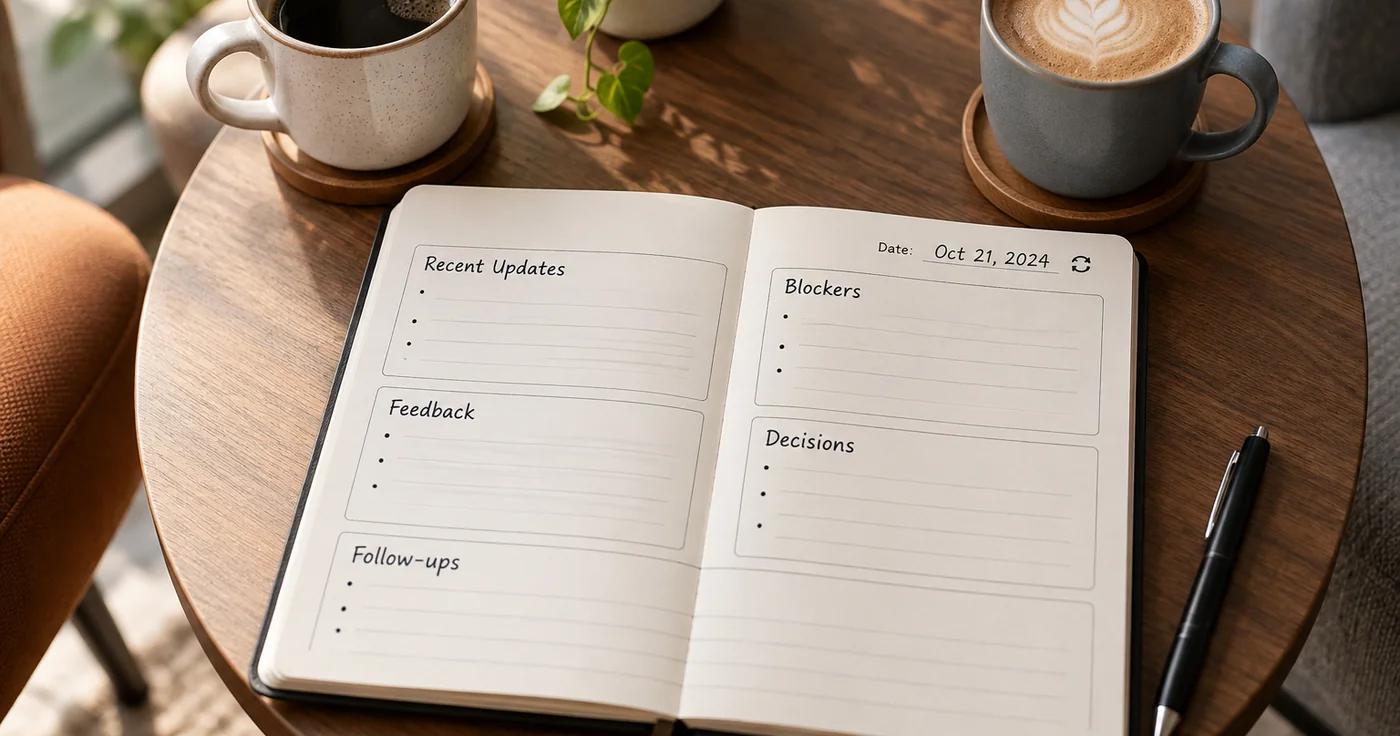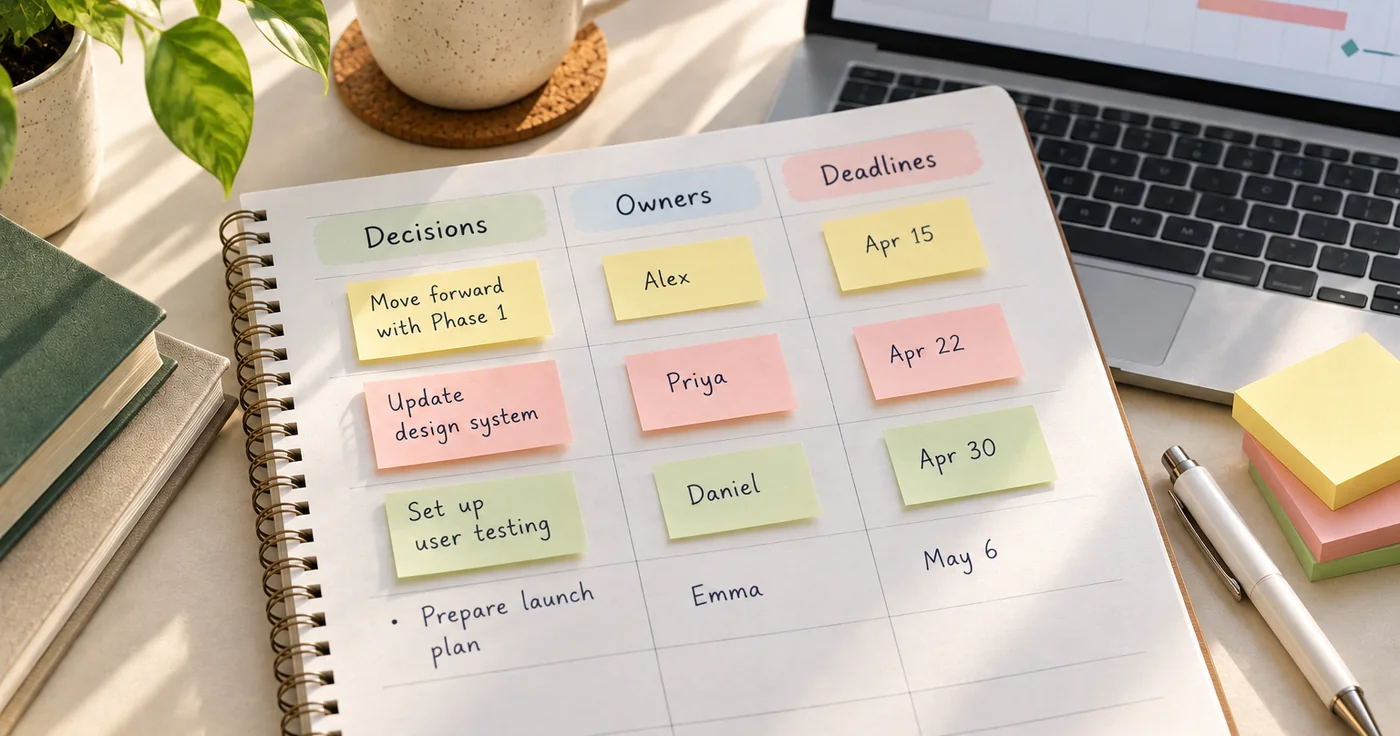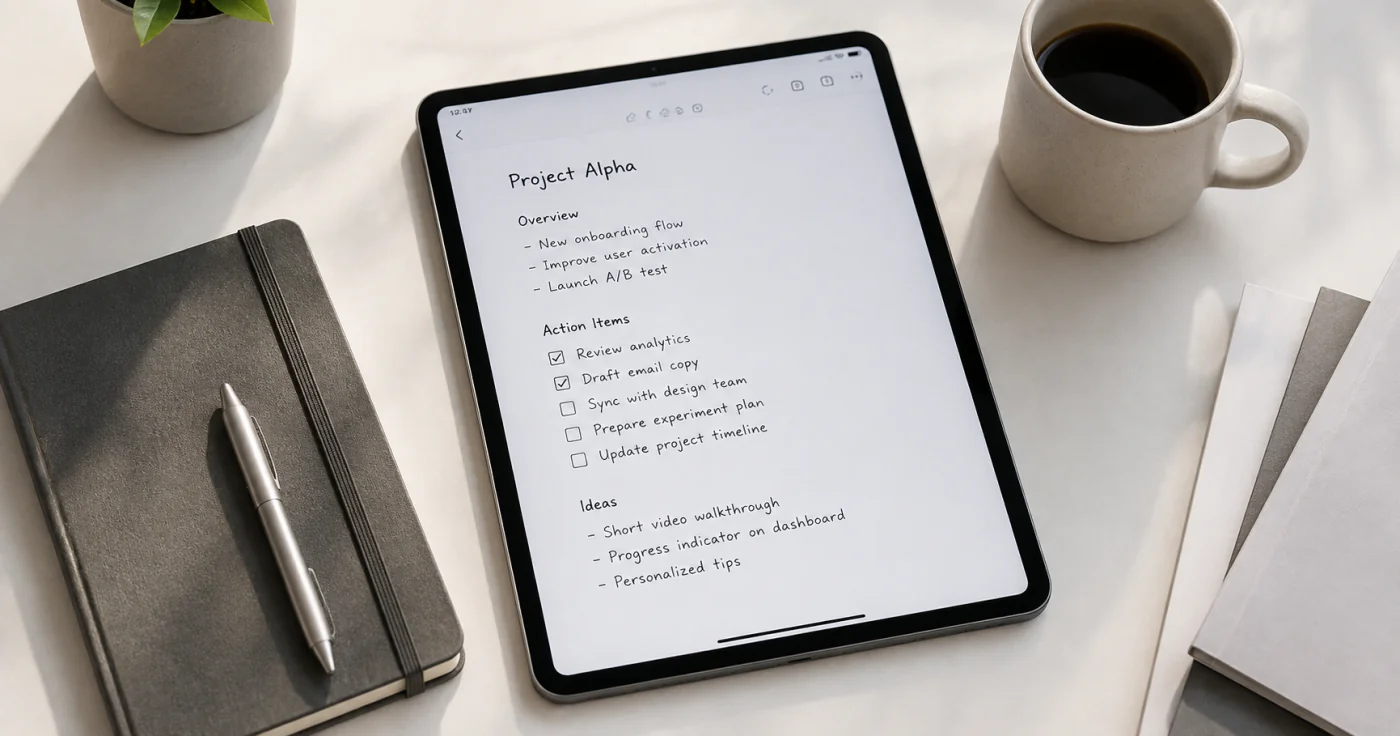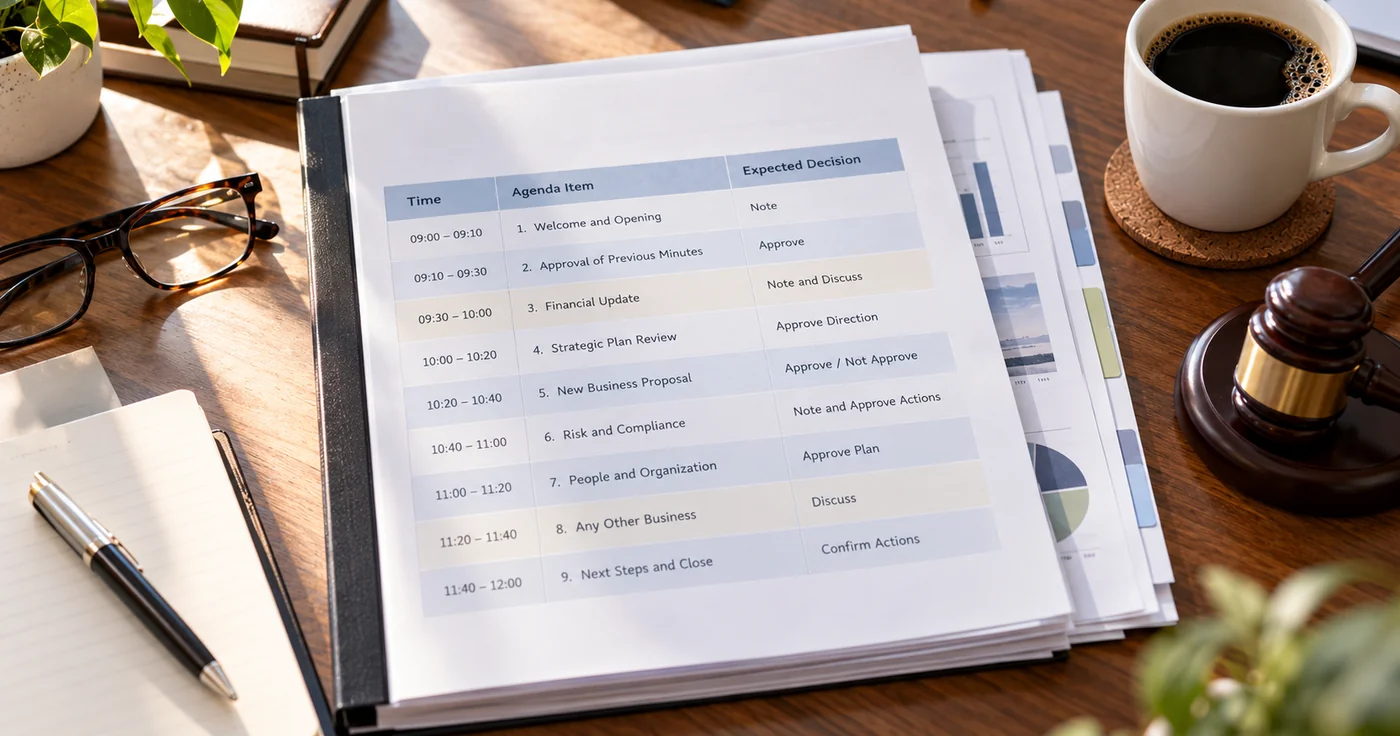
A board meeting agenda should show what members need to review, discuss, decide, or note—and what preparation each item requires. Start with the meeting details, then list agenda items in priority order with an intended outcome, time, presenter, and supporting material. Adapt the structure to your board’s governing documents and procedures.
What makes a board agenda different?
A board agenda is more than a list of topics. Members need to know which items require a decision, what background to read in advance, and how much meeting time each discussion should receive. An agenda can also make the later meeting record easier to organize because discussion and decisions are already grouped by item.[1]
Board agendas vary by organization, meeting purpose, and applicable rules. Use the format below as an editable working structure—not a statement of legal requirements. Check your bylaws, charter, board calendar, and secretary’s guidance before using formal motions, consent items, or closed sessions.
Copyable board meeting agenda format
BOARD MEETING AGENDA

Organization:
Meeting date and time:
Location or meeting link:
Meeting chair:
Prepared by:
Expected attendees:
Materials distributed by:

1. Call to order and opening items — [time]
   Lead:
   Intended outcome: Open the meeting; confirm agenda and any required opening items.

2. Consent or routine approvals — [time, if used]
   Items/materials:
   Intended outcome: Approve or note items under the board’s established procedure.

3. Updates and reports — [time]
   Presenter:
   Pre-read:
   Intended outcome: Note, discuss, or refer for follow-up.

4. Decision item: [specific question or proposal] — [time]
   Presenter:
   Decision needed:
   Options or recommendation:
   Pre-read/materials:
   Intended outcome: Decide / defer / request more information.

5. Discussion item: [topic] — [time]
   Lead:
   Question for the board:
   Pre-read/materials:
   Intended outcome: Discuss / provide direction / identify next step.

6. Follow-up from previous meetings — [time]
   Open actions and owners:
   Intended outcome: Confirm status, next owner, and target date.

7. Future agenda items and close — [time]
   Proposed future topics:
   Next meeting:
   Intended outcome: Confirm what should be prepared next.
Use only the sections that apply. If your board uses a consent agenda or another formal approval process, follow its established procedure; do not add one just because it appears in a sample format.
How to prepare the agenda before the meeting
1. Start with carryover items and the board calendar
Review the previous agenda and action list for unfinished work. Check the board’s annual calendar for topics that need to recur, such as planned strategic discussions or scheduled reports. Ask the chair, secretary, executives, or committee leads for proposed items, then confirm which topics are ready for board attention.
2. Decide the purpose of each item
Label each item so members can prepare for the right kind of participation:
- Decision: What specific choice or approval is needed?
- Discussion: What question or direction should the board address?
- For noting: What information should members acknowledge without a full discussion?
- Information session: What context will help members understand a later decision?
Avoid a vague heading such as “Finance.” Prefer a topic plus an outcome, such as “Quarterly forecast — discuss assumptions and decide whether to request a revised scenario.” Clear outcomes help the chair protect time for the items that need a decision.
3. Put decision materials in members’ hands early
For each decision item, identify the recommendation or question, the person presenting it, and the materials members should read. Keep the agenda and supporting papers clearly connected, and state when members should receive them. The Australian Institute of Company Directors advises screening items for readiness and ensuring there is enough time for accompanying documents before placing an item on an agenda.[2]
If a proposal is not ready for a productive discussion or members cannot receive essential materials in time, consider moving it to a later meeting when possible. This is a planning choice, not a substitute for any required deadline or procedure.
4. Order items and allocate time deliberately
Put time-sensitive or high-priority decisions where the group has enough time and attention to address them. Reserve realistic discussion time, include short transitions, and avoid filling every minute. Reports that only need acknowledgment may take less time than a complex decision; topics that need deeper analysis may need a separate session.
5. Send the agenda with clear preparation instructions
Distribute the agenda and related materials using your organization’s approved process. For each item, specify what members should do before the meeting: read a paper, compare options, submit a question, or arrive ready to make a decision. If there are confidentiality or access rules, use the board’s approved channel.
A filled example: quarterly budget decision
4. Decision: Approve the revised quarterly budget — 25 minutes
   Presenter: Treasurer
   Decision needed: Approve the revised budget or request a revised draft.
   Pre-read: Current forecast, prior-quarter comparison, and assumptions summary.
   Preparation: Review the largest changes and submit questions to the secretary by Tuesday.
   Intended outcome: Record the decision, any conditions, and the owner/date for follow-up.
This example makes the decision and preparation visible without prescribing the board’s voting language or procedure. If your board requires a formal motion, resolution, or record format, use the wording and process approved for your organization.
Keep the agenda and the meeting record connected
During the meeting, the secretary or designated minute-taker can use agenda headings to organize notes. Record the decision or direction, any assigned action and owner, and the next review point according to the organization’s minutes policy. The agenda is a preparation tool; it does not replace the official minutes or other required records.[1]
For general note-taking during workplace meetings, see how to take meeting notes. For a broader system for recording and tracking work, see work notes and organization.
Frequently Asked Questions
What is a typical agenda for a board meeting?
Many agendas include opening items, routine approvals if the board uses them, reports, decision and discussion items, follow-up actions, future topics, and adjournment. The exact order depends on the organization’s purpose and governing procedures; use the sections that fit rather than treating one sequence as universal.[2]
What are five things to include in a meeting agenda?
For each important item, include the topic, intended outcome, presenter or lead, time allocation, and relevant pre-read or supporting material. For the meeting overall, also show the date, time, location, chair, and preparation deadline.
How do you write an agenda for a board meeting?
Begin with carryover actions and upcoming board-calendar items, clarify what each proposed topic needs from the board, prioritize decision items, attach or identify pre-read materials, assign realistic time, and distribute the agenda through the organization’s approved process. Check the final version against the board’s own rules and deadlines.[2]
Conclusion
Build the agenda around the outcomes members need to produce, not just the topics someone wants to mention. Make decisions, preparation, and time visible before the meeting so the board can use its discussion time deliberately.
For the next meeting, choose one decision item and add its question, presenter, pre-read, time, and intended outcome; then review that entry with the chair or secretary.
References
- Boardable. "Board Meeting Agenda Guide & Free Template" Updated July 6, 2026
- Australian Institute of Company Directors. "Template board meeting agenda"