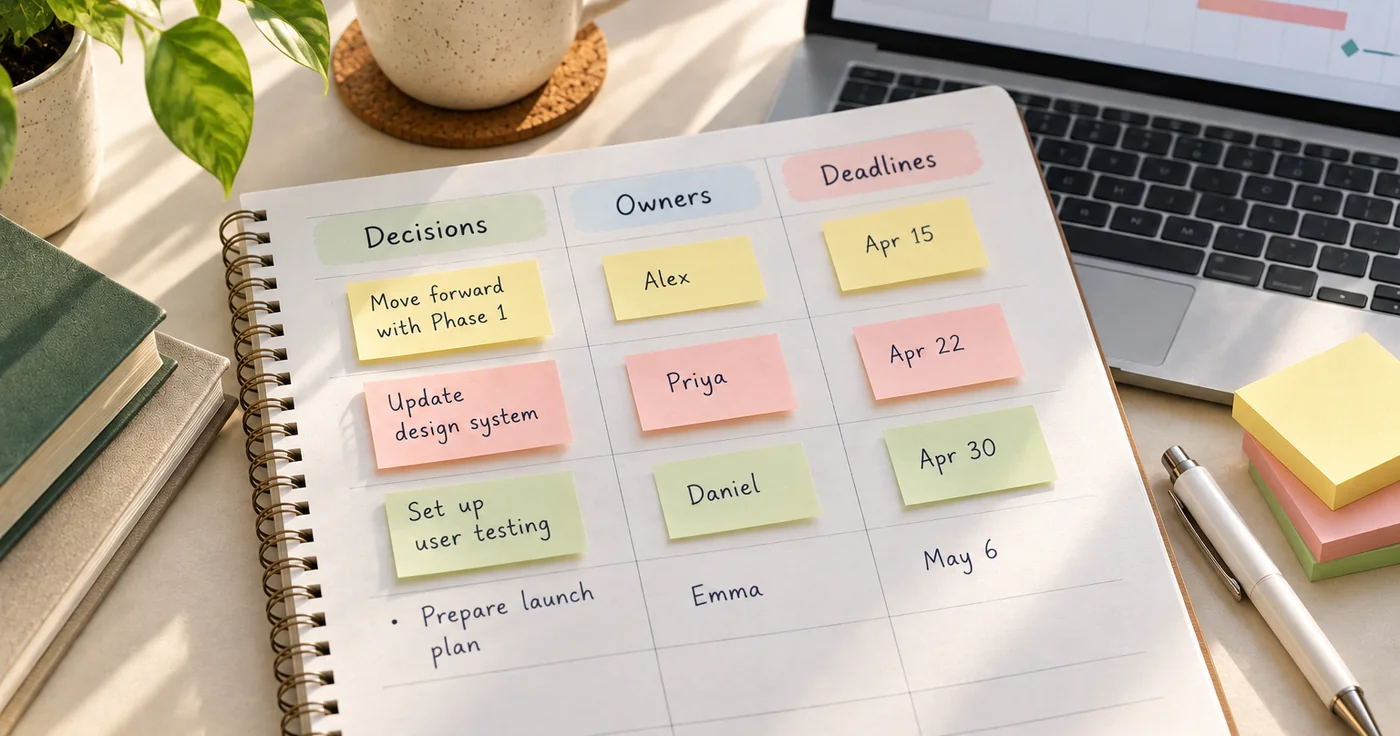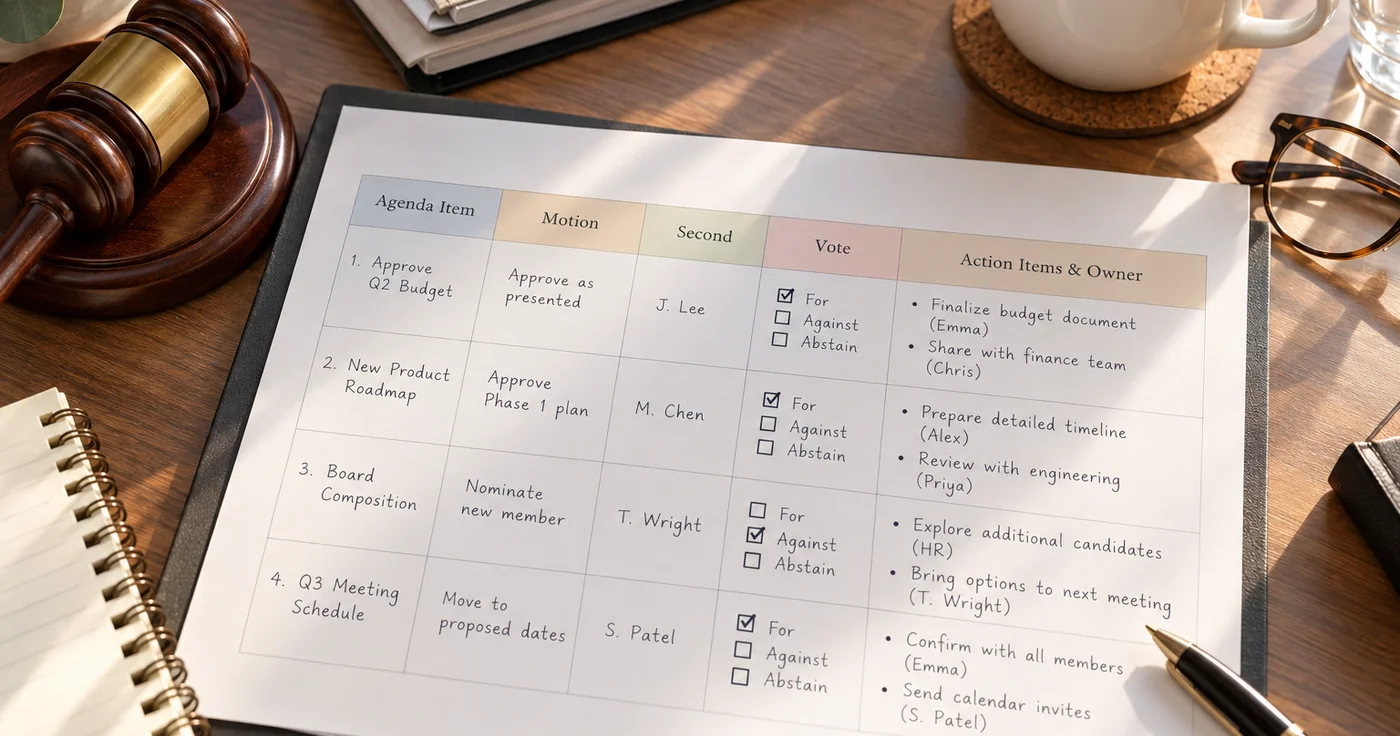
Use this board meeting minutes template to capture the meeting’s decisions, motions, vote results, and assigned actions in a clear record. It is a general administrative framework—not a legal form. Adapt it to your organization’s bylaws, board procedures, and applicable requirements before treating it as official minutes.
Copyable board meeting minutes template
ORGANIZATION:
BOARD / COMMITTEE:
MEETING TYPE: Regular / Special / Annual / Other
DATE:
TIME CALLED TO ORDER:
LOCATION OR MEETING FORMAT:
PRESIDING OFFICER:
RECORDER:

ATTENDANCE
Voting members present:
Voting members absent:
Guests or staff present:
Quorum status (as determined under governing rules):

1. CALL TO ORDER
Called to order at:

2. APPROVAL OR CORRECTION OF PRIOR MINUTES
Document/date reviewed:
Action taken and result:

3. REPORTS AND CONSENT ITEMS
Item:
Action or follow-up, if any:

4. BUSINESS AND DECISIONS
Agenda item:
Brief record of the matter considered:

Motion or resolution text (use the wording adopted by the board):
Proposed by (if recorded under your procedure):
Seconded by (if required or recorded under your procedure):
Vote method:
Vote result: In favor ___ / Opposed ___ / Abstained ___ / Other ___
Decision: Adopted / Not adopted / Tabled or deferred / No vote taken
Conflict or recusal note, if applicable under your procedure:

5. ACTION ITEMS
Action | Owner | Due date or next review | Related agenda item

6. NEXT MEETING
Date/time or scheduling status:

7. ADJOURNMENT
Adjourned at:

MINUTES STATUS: Draft / Submitted for review / Approved
APPROVAL DATE, IF APPLICABLE:
Use the motion-and-vote block once for each item that resulted in a formal motion, resolution, or vote. If the board discussed an item but took no action, record that no vote was taken rather than implying approval.
Record motions, decisions, and votes precisely
For each action item on the agenda, capture the decision in a way that lets a reader distinguish discussion from board action:
| Record field | What to enter |
|---|---|
| Agenda item | The item number or heading used in the meeting materials |
| Motion or resolution | The wording the board acted on, as recorded under its procedure |
| Mover / seconder | Names only where the organization’s rules call for or use them |
| Vote method and result | The method used and the result in the form the board records |
| Outcome | Adopted, not adopted, deferred, or no vote taken |
| Follow-up | The action, responsible person, and due date or next review |
Do not turn a discussion summary into a decision. If wording is amended during the meeting, record the version actually put to a vote and the resulting outcome. Use your board’s defined procedure for quorum, voting, abstentions, recusals, and approval of minutes; this template does not determine those rules.
A short illustrative motion entry
The example below is fictional and shows only how the fields can be organized. It is not recommended resolution language for a real board.
Agenda item: 4 — Equipment purchase
Brief record: The board reviewed the proposed replacement schedule and cost options.
Motion: “Authorize staff to obtain two additional written quotes and return with a recommendation at the next meeting.”
Proposed by: [Name, if recorded under the board’s procedure]
Seconded by: [Name, if required or recorded]
Vote method: [As recorded under the board’s procedure]
Vote result: [Enter the actual result; do not infer unanimity]
Decision: [Enter the actual outcome]
Action: Obtain quotes | Owner: [Name] | Due: [Date or next meeting]
Never fill in vote counts, quorum, approvals, or names from memory after the fact. If a detail is uncertain, flag it for verification against the meeting record and the organization’s procedure.
Nonprofit board minutes: add only the fields that apply
Nonprofit organizations may need to record additional governance information, such as how a conflict was handled or what action the board took. Do not assume every board uses the same format. For example, the IRS Form 990 instructions ask certain filers about contemporaneous documentation of governing-body and authorized-committee meetings and actions, and describe documentation as permitted by state law; the instructions define “contemporaneous” using a timing rule tied to the next meeting or 60 days after the action.[1]
That reporting guidance is not a universal minutes template and does not establish that this sample is sufficient for your organization. Check your governing documents and current requirements for your entity and jurisdiction; ask qualified counsel when the record concerns a legal obligation, conflict, transaction, or disputed vote.
| Possible field | Add when |
|---|---|
| Conflict disclosure and handling | Your policy or governing procedure calls for it, or the item raises a potential conflict |
| Resolution text | The board adopted a formal resolution or needs its exact text preserved |
| Executive or closed session record | Your rules require a record of the session while protecting details that should not appear in general minutes |
| Approval history | Your procedure tracks who reviewed or approved the minutes and when |
Keep official minutes distinct from the action list
Minutes preserve what the board considered and decided under its own process. An action list makes follow-through easy to scan. You can keep the action table inside the minutes or maintain a separate working log, as long as the approved record and assigned tasks remain aligned.
For a general team-meeting format, see How to Take Meeting Notes. For reusable layouts for daily work and project updates, see Work Notes Templates; those formats are not substitutes for board-specific governance procedures.
Conclusion
Use the template to separate the matter considered, the board’s actual decision, and the owner of each follow-up action. Before the next meeting, compare the fields with your organization’s governing rules and ask the board secretary or counsel to review any jurisdiction-specific requirements.
References
- Internal Revenue Service. "Instructions for Form 990 Return of Organization Exempt From Income Tax (2025)"