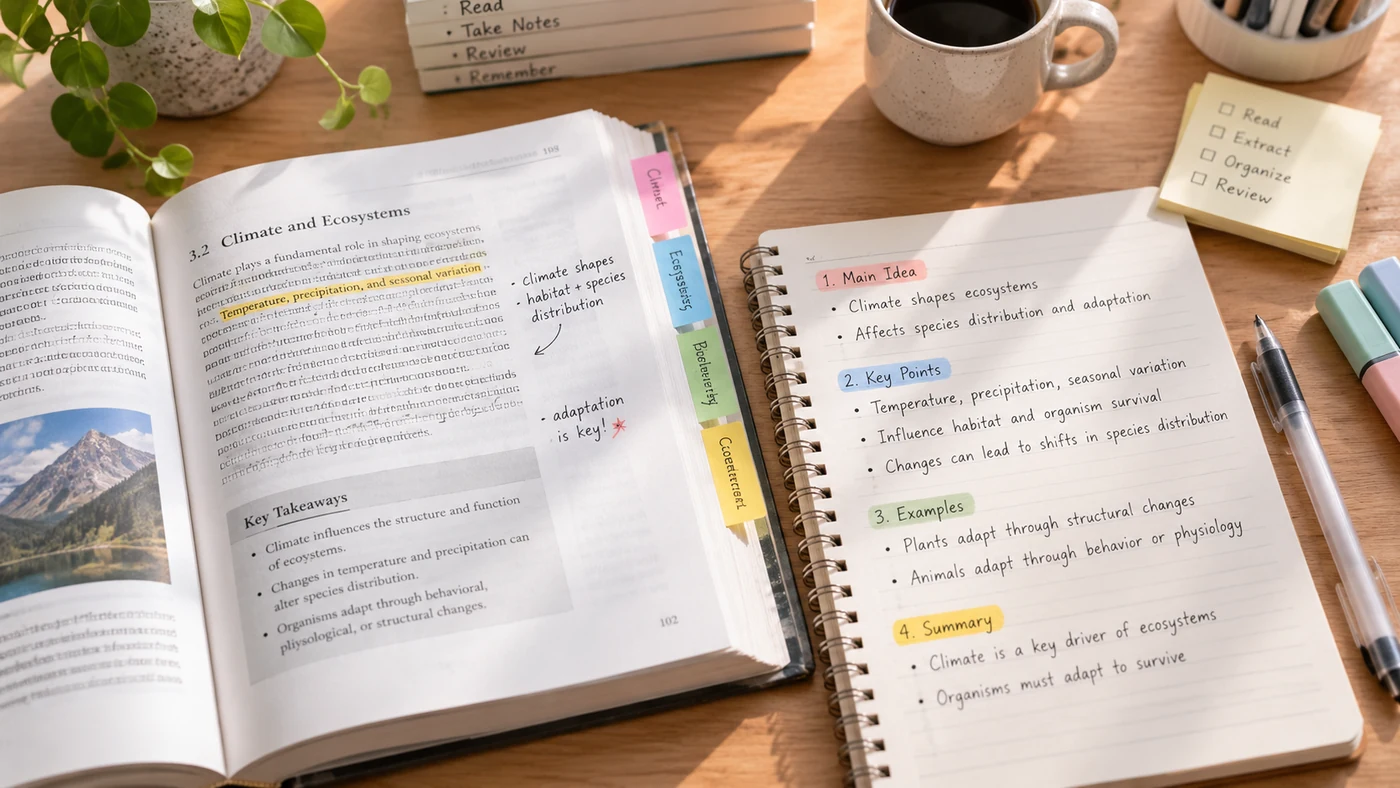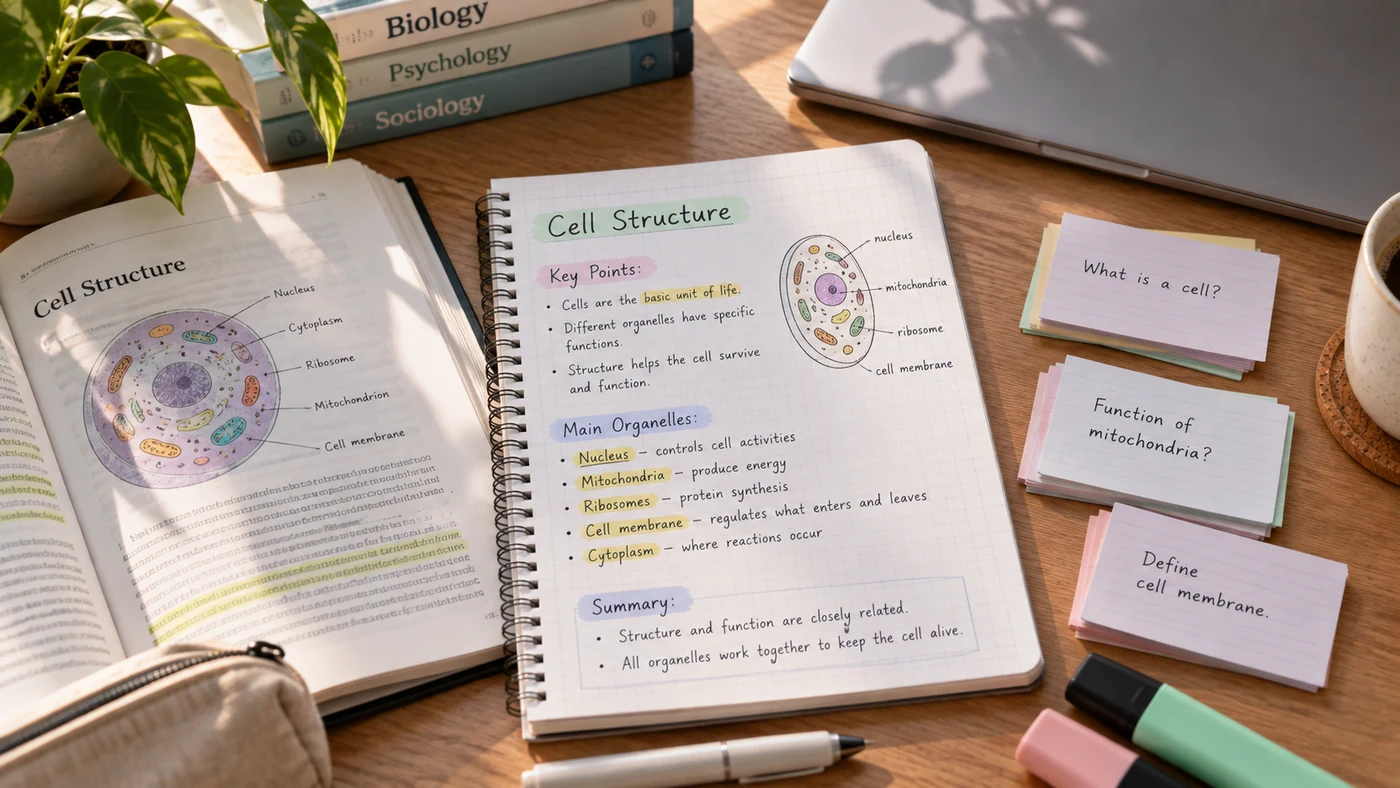
To study for exams, turn your class notes into questions, answer them from memory, check gaps against course materials, and revisit difficult topics across several sessions. Then use practice problems or timed responses that resemble the exam. This approach makes each review session purposeful instead of another pass through pages that only look familiar.
1. Define what the exam asks you to do
Start with the syllabus, instructor guidance, quizzes, assignments, and any sample questions. Identify the exam format and the skills it tests: recalling definitions, explaining relationships, solving problems, comparing ideas, or building an argument. The format determines how you should practice.
Next, make a short topic list from lecture headings, reading notes, and feedback on past work. Group related details under broader concepts. A useful review map is not a second set of complete notes; it is a guide to what you must be able to explain or do.
Princeton’s exam-preparation guidance recommends using course materials to identify central concepts, predict likely question types, and practice applying knowledge rather than merely deciding that a topic feels familiar.[1]
2. Turn notes into retrieval questions
For each major heading or concept in your notes, write one or more questions that require an answer without looking. For example:
- Definition: What does this term mean, in my own words?
- Connection: How does this idea relate to the previous unit?
- Process: What are the steps, and why does each matter?
- Application: What would happen if one condition changed?
- Evidence: Which example or result supports this claim?
Close your notes and answer on a blank page, aloud, with a flashcard, or by solving a problem. Then reopen the source and correct the answer in a different color or in a separate “gaps” list. Keep the correction specific: “I confused the two stages” is more useful than “review chapter 4.”
This is retrieval practice: attempting to produce an answer before checking the source. Portland State University’s study-strategy guide distinguishes this active work from passive review such as rereading, and suggests turning headings into questions, summarizing in your own words, and attempting problems before consulting notes.[2]
3. Match practice to the subject
Use the kind of output the exam requires. A note-based review plan should include practice, not just a reading schedule.
| If the exam asks you to… | Practice by… | Check your notes for… |
|---|---|---|
| Recall terms or short answers | Answering prompts from memory, then checking definitions | Missing details and wording that changes the meaning |
| Explain a process | Drawing the steps or explaining them aloud without notes | Order, cause-and-effect, and skipped transitions |
| Solve quantitative problems | Trying representative problems before viewing worked solutions | The step where your reasoning breaks down |
| Compare concepts | Writing a short comparison from memory | Similarities, differences, and the conditions for each |
| Write an essay | Outlining a likely prompt and supporting points under a time limit | Whether evidence and examples support the argument |
Princeton recommends practicing problem-solving and essay responses in forms similar to the exam, then reviewing the gaps revealed by that attempt.[1] Use instructor-provided materials when available; do not assume an old exam or online quiz matches the current test.
4. Build a realistic review plan
List the topics you need to review and mark each one as ready, uncertain, or not yet understood. Schedule more retrieval and practice for uncertain topics; reserve a brief final check for material you can already explain. If a topic is not understood, add a step to ask an instructor, teaching assistant, or study partner instead of repeatedly rereading it alone.
Spread sessions across the time you have. A practical cycle is:
- First pass: make questions from notes and attempt a short recall check.
- Next session: answer the questions again without notes; solve a new or similar problem.
- Later session: mix this topic with an earlier one and explain the connection.
- Final check: do a timed set or outline, then review only the errors and uncertain points.
There is no universal spacing interval or number of study hours that suits every course. Use the exam date, amount of material, other commitments, and your results on practice attempts to set the cadence. Princeton advises setting clear goals for each study block and making a realistic schedule; Portland State describes spaced practice as distributing sessions over time rather than compressing them into one sitting.[1][2]
A simple weekly example
If an exam is one week away, you might use short sessions on several days rather than trying to learn every topic in one long sitting. For example:
| Day | Main task |
|---|---|
| 1 | Map topics; turn the first units into questions; mark gaps |
| 2 | Recall and practice the weakest unit; check corrections |
| 3 | Review another unit; mix in a few questions from Day 2 |
| 4 | Work through representative problems or likely short answers |
| 5 | Try a timed section; use results to choose the final review topics |
| 6 | Revisit errors and explain key connections from memory |
| 7 | Do a brief confidence check and prepare materials; avoid adding a large new workload |
Treat this as an adjustable example, not a required schedule. A final exam covering several months may need a longer plan, while a small quiz may need only a few focused review blocks.
5. Keep one feedback loop for every session
End each study block by recording three things: what you could answer, what you missed, and what you will do next. A compact log might look like this:
| Topic | Recall result | Next action |
|---|---|---|
| Cell division stages | Mixed up two stages | Draw and label from memory tomorrow |
| Energy equations | Could explain the setup, missed units | Solve two problems and check units |
| Essay theme | Main claim is clear, evidence is thin | Find one course example and outline again |
This prevents the plan from becoming a list of hours completed. If the same gap remains after another attempt, change the action: ask a question in office hours, review a worked example, or get feedback on an explanation.
For a deeper look at arranging class material into usable study pages, see student note-taking approaches. If you want a reusable page structure for organizing review material, the student study-notes layouts can provide a related starting point.
Frequently Asked Questions
What is the best study method for exams?
There is no single method that fits every subject or exam. A reliable starting point is to retrieve answers from memory, check them against course materials, and practice the type of response the exam requires. Adjust the method based on what your practice attempts reveal.[1][2]
How long should I study each day?
There is no universal daily hour target. Set a realistic block with a clear task, such as answering ten questions or completing a problem set, and stop to assess what you can now do without notes. The time needed depends on the exam, the amount of material, and your current gaps.[1]
Conclusion
Use your notes as the source for questions and corrections, not as a script to reread from start to finish. Choose practice that resembles the exam, then let your errors decide what gets another session.
For your next study block, pick one topic, write three questions from your notes, answer them closed-book, and schedule a later attempt for anything you missed.
References
- Princeton University McGraw Center for Teaching and Learning. "Preparing for Exams"
- Portland State University Student Academic Support Services. "Study Strategies"