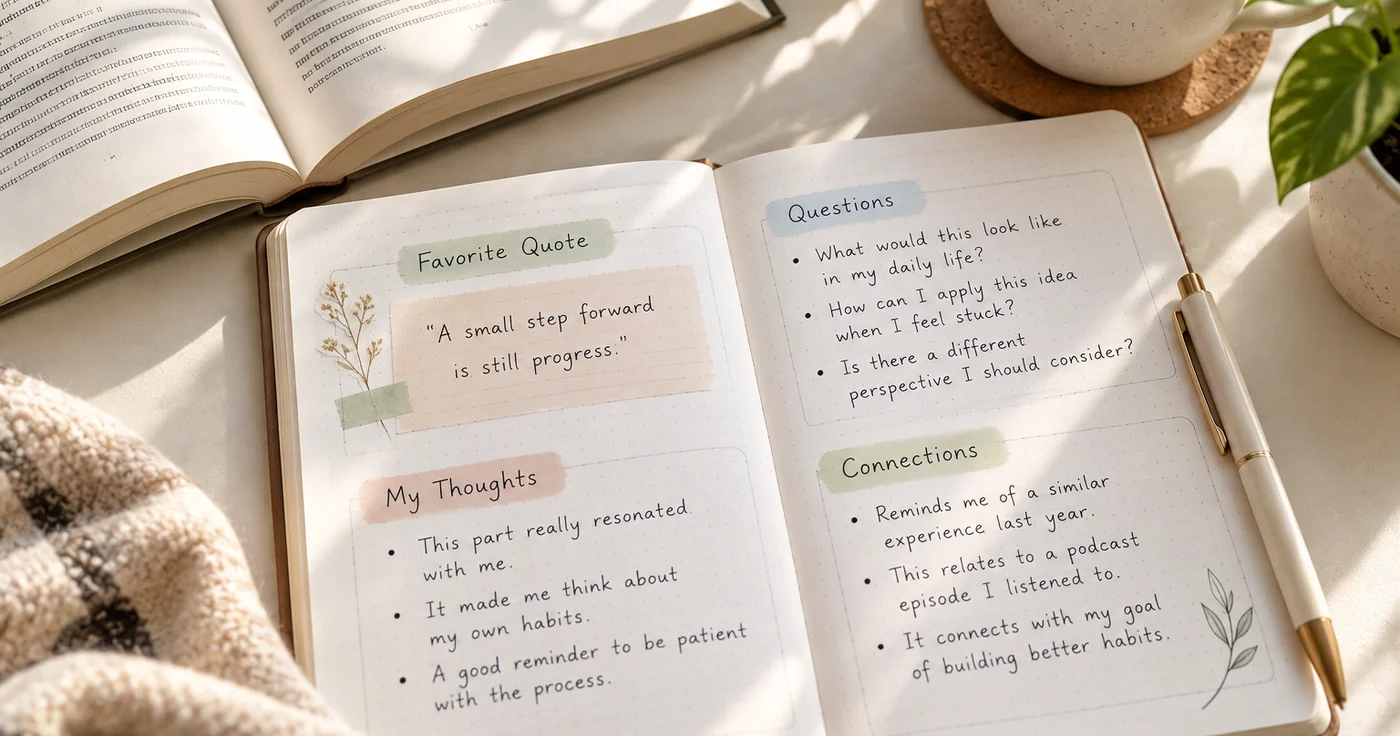
A reading journal captures what a book made you notice, feel, and wonder; a tracker records titles, ratings, or pages read. After a session, write a few lines about one moment that stayed with you, one question, and one connection to your life or another story. Use the one-page layout below to start.
Decide what belongs in your reading journal
Keep the focus on your experience as a reader. You do not need a chapter-by-chapter summary or a polished review. A short entry can capture:
- A scene, idea, or character choice you keep thinking about
- Your reaction, including mixed feelings or a change of mind
- A question the book left open for you
- A connection to another book, a conversation, or your own life
- What you might notice differently if you return to the book
If your main goal is to retrieve arguments, quotations, and source details for later work, use a more systematic book-notes approach. Your reading journal can sit alongside those notes without duplicating them.
Make an entry in four small moves
1. Name the book and your stopping point
Write the title, author, date, and the page or chapter where you stopped. If you finished the book, mark it as finished. This gives a future entry enough context without making you fill in a lengthy form.
2. Choose one memorable moment
Describe a moment in your own words. It could be a decision, an image, a line of dialogue, or an idea that challenged you. You can note a page number if you want to find it again, but do not stop writing because you cannot remember the exact wording.
3. Write your response before your summary
Ask yourself, “Why did this stay with me?” The answer might be surprise, frustration, recognition, or uncertainty. It is fine to disagree with the book or to have no clear opinion yet. This response is the part a plot summary cannot preserve for you.
4. Leave yourself a way back in
End with one question or a brief “revisit later” note. You might want to compare your reaction with the ending, discuss it with someone, or look back after reading a related book. There is no need to turn every entry into a task.
A copyable one-page reading journal layout
Use only the lines that help. The blank space is intentional; it keeps the entry from feeling like a worksheet you have to complete.
Book / author:
Date / stopping point:

Moment or idea I want to remember:

My reaction, and why:

A question I still have:

A connection I noticed:

One thing to revisit after I finish:
Here is a hypothetical entry for an invented novel, used only to show how short an entry can be:
Book / author: An invented mystery novel / example author
Date / stopping point: October 14 / halfway through

Moment or idea I want to remember:
The two siblings tell different versions of the same childhood event.

My reaction, and why:
I trusted the older sibling at first, but now I am not sure whether
confidence is the same thing as honesty.

A question I still have:
What does the younger sibling gain by staying quiet?

A connection I noticed:
It reminds me how family stories can change depending on who tells them.

One thing to revisit after I finish:
Whether my view of the older sibling changes again.
The example is a reflection, not a review or a claim about a real book. Your own entry can be two sentences rather than a full page.
Reading journal ideas for different reading moments
You do not need one elaborate spread for every book. Choose an entry style that fits what happened while you were reading:
- Quick reaction log: After a session, record the stopping point and the one moment or idea you keep thinking about.
- Quote-and-response note: If a passage stands out, note its page or chapter and write your own response in a sentence. A page reference is enough; the journal does not need to reproduce a long passage.
- Question trail: Keep the questions that accumulate as you read, then mark which ones the ending answered and which remain open.
- Book-to-book connection: When you finish a book or begin a related one, note a theme, character choice, or idea you want to compare.
These are options, not sections you must fill in. A tracking spread records progress across books; a reflective entry records your experience of one book. You can keep both, but they answer different questions.
Try prompts that deepen the entry, not lengthen it
If you are stuck, choose just one question that fits the book:
- Which part did I want to tell someone about immediately?
- When did I feel close to a character—and when did I pull away?
- What assumption did this book make me notice in myself?
- Which question would I ask the author or a character?
- What did I expect at the beginning that I no longer expect now?
- Which small detail might mean more once I know the ending?
For a nonfiction book, you can replace “character” with “idea” or “argument.” If you would rather establish a broader writing habit first, start with a simple journaling routine and use reading as one possible subject.
Revisit without turning reading into homework
You do not need to make an entry every time you open a book. Try writing after a chapter that changes your view, at the halfway point, and after you finish. When you complete a book, reread your first entry and add two lines: What changed? What still feels true?
Keep a separate list for books you want to start or recommend. That list answers “What should I read next?”; the journal answers “What was it like to read this?” If you want ideas for the first kind of list, see reading and movie list ideas.
Conclusion
Keep a reading journal for the reactions you would otherwise forget, not for a perfect record of every chapter. One moment, one honest response, and one open question are enough to make an entry worth returning to.
Try the one-page layout after your next reading session, then remove any field you never find useful.