There is no single "best" note-taking method. The right one depends on what you are capturing and how you will use the notes later. Below, we compare the three methods that show up in almost every study — Cornell, outline, and mind map — with a concrete example of each, a side-by-side table, and the mistakes that quietly waste your study time.
Match the Method to the Material
The fastest way to decide: ask what the source looks like. A lecture that moves in a clean sequence favors one method; a tangle of connected ideas favors another. Switching methods in seconds is the actual skill — top students do not use one notebook for everything.
Method 1 — Cornell Notes
Developed at Cornell University in the 1950s, the Cornell system splits the page into three zones: a notes column (right, ~70%) for capture during class, a cue column (left, ~30%) for questions and keywords added after, and a summary strip at the bottom. The cue column is the genius — cover the notes and quiz yourself with it.
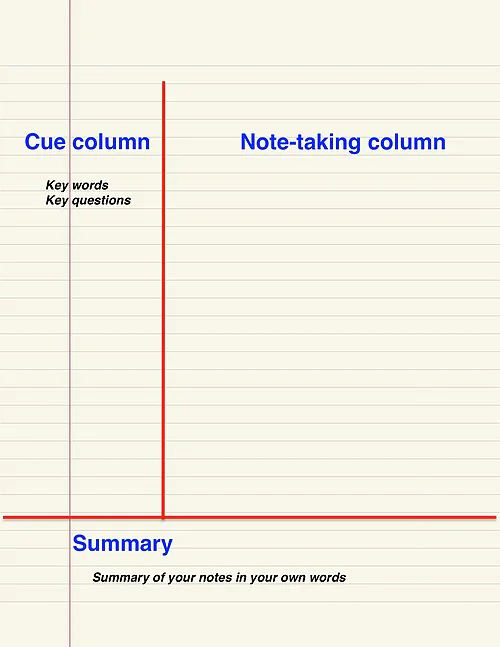
Example (a biology lecture on photosynthesis):
- Notes column: "Light reactions happen in the thylakoid — produce ATP + NADPH. Calvin cycle runs in the stroma — fixes CO₂ into glucose. Both occur in the chloroplast."
- Cue column: "Where do light reactions occur? What does the Calvin cycle produce?"
- Summary: "Photosynthesis = light reactions (ATP/NADPH) + Calvin cycle (CO₂ → sugar). Two stages, same chloroplast."
Best for: lectures, exam prep, anything where you want notes that double as self-test tools.
Method 2 — Outline Method
The outline method uses hierarchical bullets: main topic, sub-points indented beneath, details indented further. It is the fastest structured method because textbooks and slide decks are already organized hierarchically — you are just rephrasing their structure in your own words. A digital app like EasyNotes nests outline bullets and tags them so they're searchable months later — handy when exam season arrives.
Example:
- I. Photosynthesis
- A. Light reactions
- 1. Location: thylakoid
- 2. Outputs: ATP, NADPH, O₂
- B. Calvin cycle
- 1. Location: stroma
- 2. Inputs: CO₂ → Output: glucose
Best for: textbook reading, numbered lectures, business or law-style content where sequence matters.
Method 3 — Mind Map
A mind map puts the central topic in the middle and branches outward to subtopics, examples, and connections. It mirrors how the brain stores ideas as networks rather than lists, which makes it strong for big-picture review and brainstorming.
Example: Center "Photosynthesis" → branches to Light reactions (thylakoid, ATP/NADPH), Calvin cycle (stroma, glucose), Inputs (sunlight, water, CO₂), Outputs (glucose, O₂).
Best for: connected concepts (history, biology systems, essay planning), revision sessions, and visual thinkers.
Other Methods Worth Knowing
- Charting — a table for compare/contrast material (great for "versus" topics).
- Sentence method — one short line per idea; fastest for rapid-fire lectures where you just need a capture net.
Comparison at a Glance
| Method | Best for | Capture speed | Review strength |
|---|---|---|---|
| Cornell | Lectures, exam prep | Medium | Highest (cue column = built-in quiz) |
| Outline | Textbooks, structured lectures | Fast | Good (scannable, condenses easily) |
| Mind map | Connected concepts, brainstorming | Slow–medium | Visual big-picture recall |
Best-Practice Rule: Review Within 24 Hours
The method matters less than what you do next. Cognitive research shows notes reviewed within 24 hours of taking them are retained far better than notes never revisited[1][2]. Paraphrase in your own words as you go — verbatim copying is the lowest-value note-taking there is.
Common Note-Taking Mistakes
- Transcribing instead of processing. Writing everything word-for-word bypasses the thinking that builds memory. Fix: summarize in your own words.
- Never reviewing. Notes you don't revisit are wasted effort. Fix: the 24-hour rule above.
- One method for everything. A fast lecture and a brainstorm need different formats. Fix: match the method to the material.
- No structure at all. A wall of text can't be scanned or studied. Fix: pick one of the three frameworks above.
FAQ
There isn't one. Use Cornell for lectures and exam prep (the cue column becomes a self-quiz), outline for textbook reading and structured slides, and mind maps for connected concepts and revision. The skill is switching methods to match the material, not forcing one format everywhere.
Yes, and most strong students do. A common workflow is outline or sentence notes during a fast lecture, then reorganize the key points into Cornell questions or a mind map for review. Capture fast, then process — that hybrid beats any single method.
The outline method is the fastest structured option because indentation does the organizing for you. For pure speed with no structure, the sentence method (one short line per idea) wins. Cornell is slower to write but saves time later because it is built for review.
Keep a consistent structure — by course or project, with a clear naming convention and tags — and review weekly so related ideas connect. Digital notes make this automatic with search and tags; paper needs a fixed notebook-per-topic system to avoid the "where did I put that?" problem.
Conclusion
Pick the method that fits what you are capturing: Cornell for lectures, outline for textbooks, mind map for connected ideas — then review within 24 hours, because the review is where learning actually happens. Try one method per class this week and keep the one that makes revision easier.
References
- Flanigan, A. E., Wheeler, J., Colliot, T., Lu, J., & Kiewra, K. A. (2024). Typed Versus Handwritten Lecture Notes and College Student Achievement: A Meta-Analysis. Educational Psychology Review, 36(3), 78. https://doi.org/10.1007/s10648-024-09914-w
- Ebbinghaus, H. (1885). Memory: A Contribution to Experimental Psychology.